Friday, 31 December 2021

My Top Five Birds of 2021

All this Covid stuff has made a lot of us take stock of our lives and what we do, and me no less than anybody else. In particular I’ve been reviewing my bird photos for some of the time and I’ve realised that I’ve got some decent shots of most common UK birds - so I’ve asked myself, ‘Do I really need any more of the same species?’

I’ve never understood why some photographers get on the annual seasonal bandwagon of having to shoot the same birds in the same location at the same time of each and every year - I mean, how many Owl, Kingfisher, Puffin, Kite, Gannet, Black Grouse, Snow Bunting, Osprey and even White-tailed Eagle shots do you really need? And then they flood the internet with countless similar images which are pretty much the same as everyone elses. Madness, and it happens every year. 

Surely less is more here and one good image is better than countless similar ones where you couldn’t decide which one was best. After a couple of shots most people scroll on or turn off.  I’ll hold my hands up and say that in the past I’ve done it too, but not any more. From now on I’ll be mainly photographing UK birds of which I’ve got no decent shots, which generally will mean seabirds and rarities. I’m not saying that I’ll never shoot one of the aforementioned species ever again, but I won’t be on the annual cycle going from one species to another (which often includes otters, deer, hares, foxes and badgers) getting even more shots to add to a library stuffed full of similar ones.

So if you’re wondering why I’ve not been posting much recently and you may have even noticed that I’ve left a lot of Facebook groups, there’s the reason. Perhaps not everyone will agree but I’m happy with my decision.

Anyway, reviewing my bird photos from this year (what else is there to do on these gloomy late December days?) here are my Top Five birds of 2021. Considering I didn't go out much this year and there were two or three months where I didn't take a single bird photograph, I'm pleased with these rarities which were all Lifers for me.

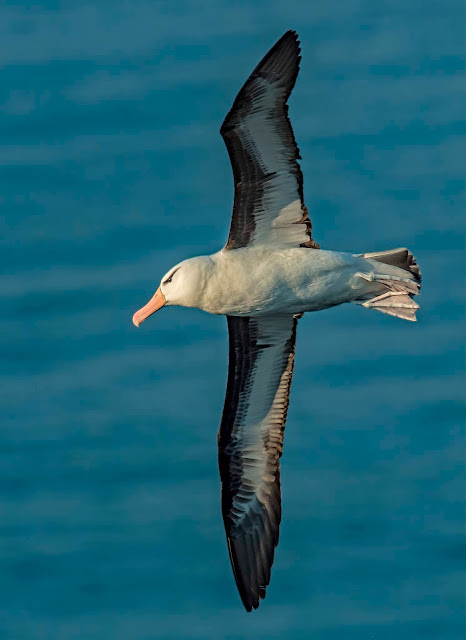
Black-browed Albatross - Bempton Cliffs RSPB, East Yorkshire

Belted Kingfisher - Roach Bridge, Lancashire

White-tailed Lapwing - Blacktoft Sands RSPB, West Yorkshire

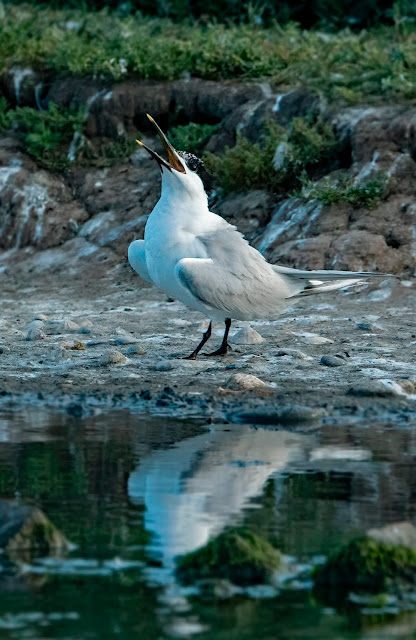
Elegant Tern - Cemlyn Bay, Anglesey

Long-toed Stint - St. Aidan's RSPB, West Yorkshire


Wednesday, 22 December 2021

What a Belter !

These days I'm only really going out for birds which I've never seen (Lifers) and those I've never seen in the Greater Manchester area.  I've missed quite a few this year as I've been concentrating on astrophotography, so it was really nice to get to see this mega rare Belted Kingfisher at on the River Darwen at Roach Bridge in Lancashire.


The BirdGuides bird alert service is using my photo for the Belted Kingfisher sightings:


Thursday, 2 September 2021

White-tailed Lapwing / Plover Thingy at Blacktoft Sands RSPB

They must have had a really hard time naming this Plover! Yellow-legged Lapwing, Long-legged Plover? No, they settled on White-tailed Lapwing which for me isn't its most obvious feature as it's beautiful white tail is only really seen in flight. I photographed this mega rare UK bird at Blacktoft Sands RSPB in East Yorkshire yesterday. It's been there over a week now and is still there today.


Wednesday, 14 July 2021

Elegant Tern at Cemlyn Bay on Anglesey


I spent a very frustrating eight hours trying to photograph this rare bird yesterday due the light, the vegetation and distance it was away. Most of my photos are destined for the bin except for a few record shots like this one - the main problem being the very bright light during midday and afternoon (yes, I should have known better to get there early) coupled with the heat haze generated by the good weather. Conditions got a bit better as the day progressed and the sun moved round and my best shots were actually taken between 7 and 8pm when it became overcast. Still not great though.


On the other hand, it was a fabulous day with good weather in a stunning location. The shingle beach, the clear water and the noise of the terns all combined to make it very memorable. The Elegant Tern seemed to be displaying at times and was quite aggressive to the Sandwich Terns amongst which it was sitting. They have been known to mate with these birds abroad. 


Every now and then the whole colony (including Arctic, Common and Sandwich Terns as well as Black-headed Gulls and the odd Oystercatcher) would take to the air en masse making a truly spectacular scene. Usually this was the result of a Peregrine Falcon patrolling the air space and indeed I witnessed a Peregrine take small birds out of the air on two occasions.

There was also a regular flow of birds going out into the bay, catching sand eels and returning, flying right over your head as they did. Young birds gathered on the shingle along the shoreline, some being fed by parents, others being chased out to sea by them as they enouraged the to fly or catch fish. In the late evening, the youngster seems to gather in a large group along the water's edge and would periodically all fly out low over the sea together in a flock - magical!

If you've never been to Cemlyn Bay you should get there sometime - June and July are best for the Terns but its a fabulous place at any time. And there's still time yet this year!

Monday, 5 July 2021

Black-browed Albatross at Bempton Cliffs


After a two and half hour journey, I turned up at 2pm to find that this very rare bird, a Black-browed Albatross, had gone AWOL and immediately my heart dropped. But I was determined to stick it out and even stay overnight for another look tomorrow if necessary. 


Fortunately I didn't need to, but it was a very long wait - the bird wasn't seen until just after 7pm when it was spotted by birders with scopes way in the distance on the sea opposite the Flamborough headland. It was another hour or more before it finally made its way to roost at Staple Newk amongst the Gannet colony, by which time the decent light had almost completely gone.


But I was still very happy to see this remarkable and majestic seabird and get some shots of it. This particular bird has visited Bempton Cliffs several times in recent years but I'm told that this is the longest time it has stayed. And if it stays any longer, I may well have another shot at it - photographically of course!

LIFER !!!

Thursday, 1 October 2020

Hoping for a Hoopoe

Two birds of my most-wanted birds for sometime now have been the Wryneck and the Hoopoe.  Well I got a Wryneck only 30 minutes from my home last month so now I was looking out for a Hoopoe. Since I've been birding, I've only known of a couple of opportunities to see one in the UK and they were a bit too far to travel.  So when one of these lovely exotic birds appeared in West Yorkshire this week, it was too good a chance to miss.

I'm not really a twitcher, preferring to take the opportunities of seeing a rare bird only if they crop up within about a two hour drive from home. I have occasionally gone further, but with a backup plan of what I'll do if the bird is no longer present - birds can fly you know, and often do! So a longer twitch often involves planning an overnight stay and a visit to a nature reserve which I wouldn't normally get to see.

However, for this bird no such planning was needed - I just jumped in the car and drove up the M62 and A1/M1 for about an hour and twenty minutes and there it was.  And I mean literally there it WAS!  I parked the car in a suburban street, walked down a ginnel for about five minutes to the Collingham and Linton Cricket Club and there was the bird was feeding on the outfield of the pitch in front of a crowd of about fifteen people. Easy-peasy and just the way I like it!

The light conditions were variable throughout the day but the bird was never very far away and it was easy to lie done on the grass verges just outside the pitch boundary perimeter to get some low profile shots.  It was feeding voraciously on bugs and grubs in the grass and could maintain extended periods of spearing the soil with its long, decurved beak, rarely moving off with out finding something to eat.  This is well demonstrated in the video below:


The UK is the northern limit of the Hoopoe's range and they are more commonly seen on the south and east coasts of England.  They winter in Africa and migrate to Spain, France and other parts of the Mediterranean in the spring and so occasionally get blown further north to the UK due to prevailing weather systems.  On average we get around 100 birds each year, but they don't breed here in the UK.


It really is an exotic looking bird with its orange-coloured crest, brownish neck, shoulders and breast and black and white barred wing feathers.  You can easily see why it drew such a crowd - it's no 'little brown job'. Since posting my photos on Facebook many people have said they are commonly seen abroad, particularly in Spain and France and often on golf courses. Well, as I have never done and don't intend on ever doing any birding abroad, I wasn't going to see them there, so I was really pleased when this little beauty came to see me!

Sunday, 20 September 2020

A Short Trip to the Whisky Isle of Islay


For our first extended motorhome trip in our recently acquired van we decided to go to Islay in the Inner Hebrides. Islay is well-known for its birds but due to Sarah's holidays we were going in between seasons really - too early for the influx of winter geese and other migrants returning from their breeding groups further north and after many of the summer visitors had left. Not to worry though, my recent interest in night sky photography and whisky gave me another reason for going - the hope of some dark skies and visiting some of the eight single malt whisky distilleries for which the island is world famous.


On the trip we saw a few birds but the only 'speciality' bird we found were four Choughs on the Ardnave headland near Loch Gruinart. We heard them long before we saw them as they make quite a different sound to other corvids. They were mainly feeding by digging in the sandbanks for insects.


The birds were quite mobile and none of these shots are particularly sharp - not having been birding for ages, I needed to get used to the weight of my camera and long lens again. It's funny how quickly you can get out of practice.

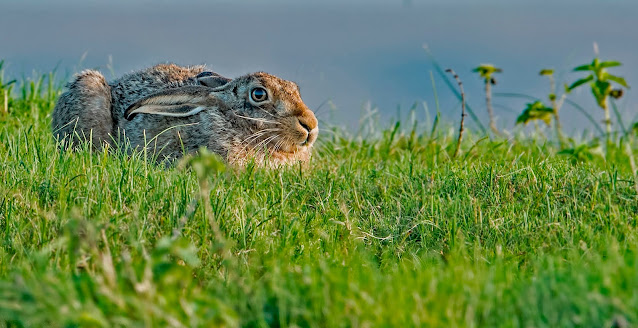
I also stumbled across this lovely Brown Hare which was laying low in the grass until it saw me - then it shot off into the distance never to be seen again.


It would have been rude not to help out the local economy whilst enjoying our short stay on Islay.


Friday, 4 September 2020

Red-backed Shrike in West Midlands

Today I called in at Sutton Park NNR in the west Midlands to see an adult male Red-backed Shrike on the way back from Cheltenham.


Monday, 31 August 2020

Bank Holiday Treat

Well, this was a great Bank Holiday surprise. I never thought I'd see a Wryneck in Greater Manchester, let alone have it giving such good views. This bird has been on my 'most wanted' list for sometime now and I was sure that I was going to need to travel to the Spurn area on the east coast to see one. 


So it was great to finally get this one so close to home and to watch it with a great bunch of people. Life and Greater Manchester tick.


Starting to get my birding mojo back now - roll on Islay in a couple of weeks!

Thursday, 6 August 2020

A Celebrity Bird appears in Derbyshire

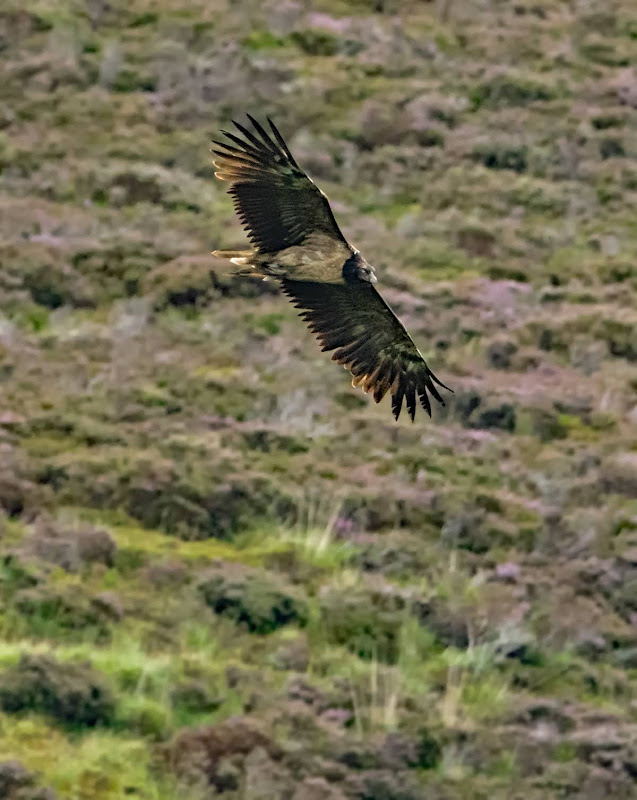
After after four month break, I returned to serious birding activities yesterday with a trip to see Derbyshire's celebrity star, the Lammergeier or Bearded Vulture. I spent over 12 hours in the valley above Crowden with fantastic company as we hoped to get some photos of this beast of a bird.  

My best shot was taken at 7:24am after the mist had cleared to reveal the bird at one of its current roost sites. After that all I had were distant shots as we watched it riding the thermals in a number of places. I'll post a few more later (jobs to do today) but I had to get one out there after a great day out. 

All these shots were taken from the Pennine Way footpath along with 10 other birders and numerous passing hillwalkers.

Sunday, 9 February 2020

Back to the Day Job

You may have noticed a little bit of lunar and night sky photography creeping into my blog recently as I slowly climb the very steep learning curve that is astrophotography.  Well that's my night job and so now I'm going back to the day job which is birding and bird photography. Ive got a few posts (listed below) to catch up on which I'll hopefully do over the next few days.  But to kick off I'm just posting four shots of some raptors I saw on the Wirral yesterday.


To do:
  • Siberian Stonechat - 5/1/20
  • Long-billed Dowitcher - 12/1/20
  • Purple Heron - 15/1/20
  • Barn owl - 15/1/20
  • Siberian Chiffchaff - 15/1/20
  • Short-eared Owls - 27/1/20
  • Starling Murmuration - 6/2/20
  • Rough-Legged Buzzard - 29/1/20
  • Wirral - 8/2/20

Wednesday, 18 December 2019

Early Riser

I couldn't sleep last night so, as the hazy moon was shining through my window, I got up at silly o'clock this morning and waited for a break in the clouds. Eventually it came and I took some shots of this waning gibbous moon. This one has turned out to be one of the sharpest moon photos I have ever taken.

But as the sky cleared I decided to also have a go at some tracked shots and I was quite pleased to get my first image of the Ring Nebula (Messier 57) even though it's far from perfect.  The Ring Nebula (is a planetary nebula in the northern constellation of Lyra. Such objects are formed when a shell of ionized gas is expelled into the surrounding interstellar medium by a star at in the last stages of its evolution before becoming a white dwarf.

This is just a single tracked shot taken with a 500mm f/4 lens plus 1.4x teleconverter on a crop sensor camera - 700mm ISO 640 f/8 @ 3 minutes. Yes, it really is that blue.


My next target was Bode's Galaxy (Messier 81) and the Cigar Galaxy (Messier 82) which can both be imaged in one shot - can you guess which is which from the photograph below?

Bode's Galaxy is a spiral galaxy about 12 million light-years away, with a diameter of 90,000 light years, about half the size of the Milky Way, in the constellation Ursa Major. Due to its proximity to Earth, large size, and active galactic nucleus (which harbours a supermassive black hole), Messier 81 has been studied extensively by professional astronomers.

The Cigar Galaxy is a starburst galaxy approximately 12 million light-years away in the constellation Ursa Major. A member of the M81 Group, it is about five times more luminous than the whole Milky Way and has a centre one hundred times more luminous than our galaxy's centre.

Next onto the Hercules Globular Cluster (Messier 13). This globular cluster consists of several hundred thousand stars in the constellation of Hercules. It's sometimes called the Great Globular Cluster in Hercules.

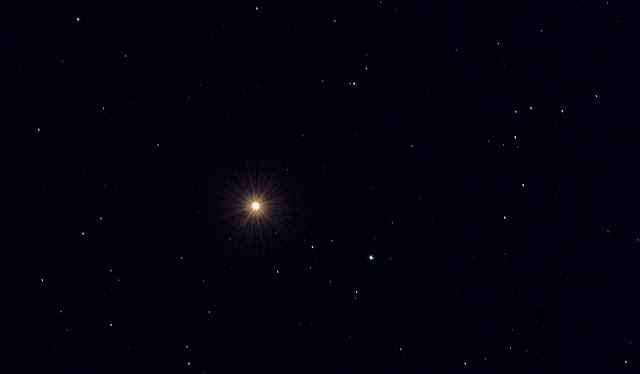
Arcturus (below) is a red giant star in the Northern Hemisphere of Earth's sky and the brightest star in the constellation Boötes (the herdsman). Arcturus is also among the brightest stars that can be seen from Earth. Astronomers say Arcturus will end up as a white dwarf at the end of its life.


Vega (below) is the brightest star in the northern constellation of Lyra. This star is relatively close at only 25 light-years from the Sun, and, together with Arcturus and Sirius, one of the most luminous stars in the Sun's neighbourhood. It is the second-brightest star in the northern celestial hemisphere, after Arcturus.

Vega has been extensively studied by astronomers, leading it to be termed “arguably the next most important star in the sky after the Sun”. Vega was the northern pole star around 12,000 BC and will be so again around the year 13,727. It was one of the first stars whose distance was estimated through parallax measurements.


And finally a quick snap of the Whirlpool Galaxy and friend (Messier 51). The Whirlpool Galaxy was the first galaxy to be classified as a spiral galaxy. It lies in the constellation Canes Venatici where it is interacting with a smaller companion galaxy. Sometimes the designation M51 is used to refer to the pair of galaxies, in which case the individual galaxies may be referred to as M51a and M51b.

But by now it was starting to get light so I struggled getting a decent image of these two galaxies. This is definitely a deep sky object to which I will be returning.


Individually, some of my images don't look much, but when viewed as a collection they start to show how varied and immense the universe really is. And boy do the constellations look different so early in the morning!