This is my favourite photo from yesterday. I've done very little processing in this shot, it's just the way the light hit the water a that particular moment. The Cormorant is almost incidental. Worth viewing at full screen size, IMHO. Here's a cropped version too. Which do you prefer?
Tuesday, 3 February 2026
Monday, 2 February 2026
Great Northern Diver at the Wigan Flashes
Friday, 30 January 2026
Great-tailed Grackle in Speke, Liverpool
With recent reports of a long-staying Great-tailed Grackle hanging around in Liverpool, I decided to head out to Speke today to get myself another lifer. After three hours of looking in all the reported spots, and in miserable damp, dark, drizzly weather, I still hadn't found it until I was joined by some other birders, one of whom eventually spotted it feeding in the distance though a fence bordering the nearby industrial estate.
By now it was 4:30pm and the light was fading fast with accompanying drizzle, so I had to ramp the ISO up high to be able to see anything among the branches. It eventually returned at 4:38pm with a couple of Magpies and settled here for about two minutes, calling a couple of times before flying away to its second roost site. Five minutes later and I would have set off back across the field for home and missed it.
I'd liked to have approached a bit closer, but there were other people present and so I didn't. We had a nice craic during the afternoon so all in all a good result, despite the miserable weather.
I was quite disappointed to find out later that although the BOU has classified this as a Category E bird, it does not form part of the British List. This is because it's not a natural vagrant, but most likely human-assisted, having probably come in on a boat via the Liverpool Docks.
Saturday, 17 January 2026
Snow Goose on the Marine Lake in Southport
A distant record shot of the Greater Snow Goose roosting with the Greylags on the marine lake at Southport yesterday. It spent a lot of time sleeping on the opposite side of the lake, so I couldn't get any close shots.
There's a lot of discussion about whether this bird is truly wild or a feral escape. Apparently it has come in with the Pink-footed Geese in the autumns of 2024 and 2025. Although of unknown origin, one very experienced birder asked me how many Greater Snow Geese have ever been in UK collections and of course neither he or I had ever heard of any. So there's a good chance it may be truly wild.
Wednesday, 8 October 2025
Little Egret on Bank's Marsh near Southport
As a bonus to seeing the Ross's Goose mentioned in my previous post, I walked a little further round the sea wall at Banks and saw this beautiful Little Egret taking off.
Although once a highly switchable bird, Little Egrets are now a common sight in the UK, particularly around the coasts and estuaries of southern England and Wales, after a range expansion from continental Europe. They first bred in the UK in 1996 and are now established with sustainable breeding populations, though they are still expanding their range further north.
They are now a resident species with sustainable breeding populations in the UK, though their numbers increase in the autumn and winter with arrivals from continental Europe.
Ross's Goose on Crossen's Outer Marsh, Southport
However, it was possible to see the distinctive bill and black wing tip feathers, so I'm happy enough with these shots. It's always difficult to know whether a goose like this is truly wild rather than an escaped bird, but after talking to several people about this, I'm happy enough to tick it.
Ross's Goose is a white goose with black wingtips and a relatively short neck. It's the smallest of the three white geese that breed in North America. It is similar in appearance to a white-phase snow goose, but about 40% smaller. Other differences from the snow goose are that the bill is smaller in proportion to its body and lacks "black lips".Thursday, 10 July 2025
Long-eared Owls from Lancashire
Today was my first visit to what has become a well-known location for Long-eared Owls, with people coming far and wide to see them here. There's also been a lot of bad feeling about photographing them and some disagreements have even turned violent. This has kept me away from the site which I've known about for around 10 years, I don't like crowds and particularly crowds of photographers, so I'd rather stay away than get embroiled in all the fuss.
However, knowing that the owlets had fledged (you can't keep anything secret for long nowadays), I decided an early midweek opportunity in decent weather should be missed. I needed something to kickstart my flailing birding mojo and I wasn't disappointed.
Long-eared Owls are mainly nocturnal hunters and like to stay buried deeply in vegetation making them normally very difficult to find and see during the day. That is, unless it's the breeding season, when they hunt during the day to feed hungry mouths. They are very prone to disturbance and will often leave an area if ti becomes too much. That said, these owls have been here a long time, and so whatever has occurred in the past, it hasn't caused them to move.
As the breeding season was largely over, I decided this was the time to go. As can be seen from the above photo, the owlets have fledged and are almost full size although they still retain their brown faces and some downy feathers.
I've only had one good view of a Long-eared Owl before with most of my previous sightings being partial and distant. Frequently it's only an eye or ear on show, with most of the bird being covered by vegetation, so to see them out in the open here is a real treat.
I did see one bird fly a couple of times but didn't manage to get a decent flight shot. So I may go back once more this year but now I know where it is I'll definitely be going again next year.
Sunday, 29 June 2025
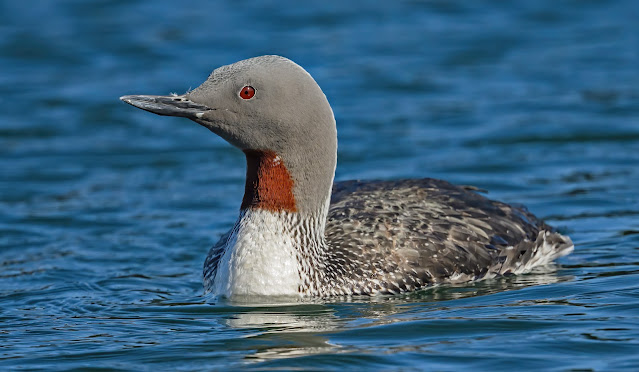
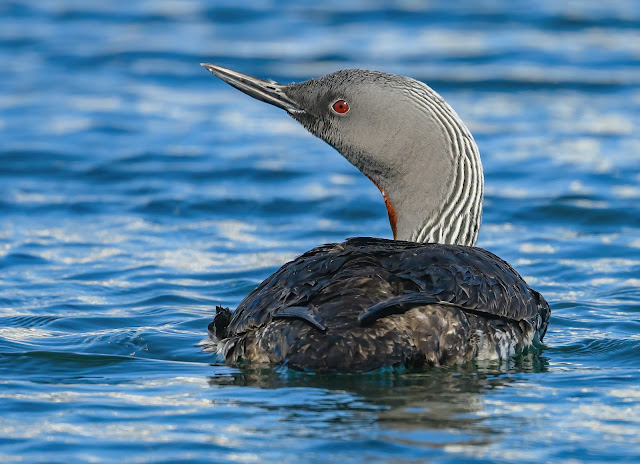
Red-Throated Diver in Amble Marina
There has been a long-staying Red-throated Diver in summer plumage at Amble in Northumberland recently and as it looked to be staying for a while more I decided to go for it today. I made the three and a half drive from Manchester to the free car park at Amble Braid and after a walking only a couple of hundred yards there it was, happily sleeping in the marina.
I've seen plenty of these birds before both on the sea and sometimes inland but usually in their winter plumage when they don't have the red throat and are mainly grey and white. So to see one so close in summer plumage was a real real treat.
Apart from the very obvious red throat, I particular like the striping on the back of the head and neck as well as the red eye.
This bird did spend a lot of time asleep or partially asleep and drifting with the flow of water in the marina. When it did awake it set off fishing amongst the boats and I lost it for a while. So I left it for a while and had a walk around Amble Harbour, a place I really like. There were the usual Eider ducks and various Gulls in the harbour area and one or two Terns diving for fish, but nothing to keep me there too long.
I returned to find the Diver asleep again but back out in the open. As I was staying in Ashington tonight, which is only 20 minutes from Amble, I could spend as long as it took to get some more photos. The bird eventually did awake and as the tide was rising and filling the marina, it came pretty close at times.
Monday, 9 June 2025
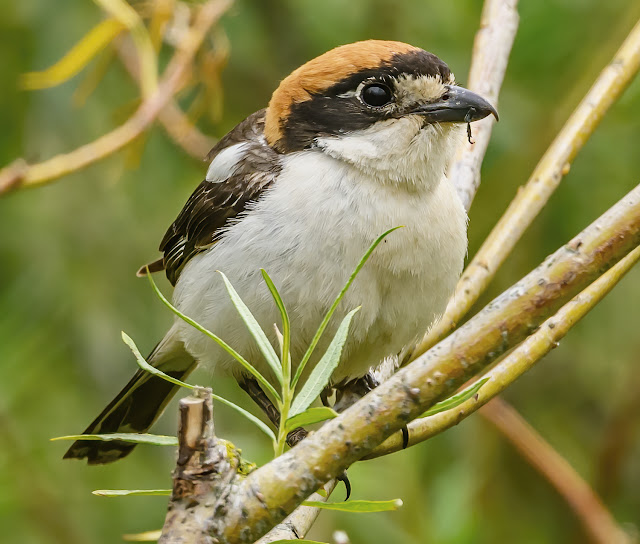
Woodchat Shrike in Daresbury - Lifer
It's been quite a while since I had a new bird to see, a Lifer as birders call them. This is really all I go out for nowadays as, since Covid, my birding mojo has at an all time low. This is despite getting a new mirrorless camera over 18 months ago, but I am determined to resume bird photography as I enjoy being out and about so much.
And even if there is a rare bird about, I tend to wait to see if it hangs around for a while - there's nothing more frustrating than going for a bird which departed before you arrived. Anyway, this Woodchat Shrike was being reported for a few days in Daresbury and so I decided to go for it.
I've seen a Red-tailed or Turkestan Shrike, a Red-backed Shrike and several Great Grey Shrikes before so this makes the fourth species I've ticked of this bird. I often think that it should be thought of a 'bird of prey' because I've seen them catch lizards and frogs and I believe they will take even small birds.