Showing posts with label Peregrine Falcon. Show all posts

Friday, 5 July 2019

BBC Countryfile Calendar 2019 Entry.

So here's my three photographs for the 2019 BBC Countryfile Calendar.  I've never done this before and I don't expect to hear anything further as they don't really fit the theme of 'Beauty and the Beast', but I had the photos anyway and thought it as worth a try.


Friday, 28 June 2019

Another Day with the Malham Peregrines

I had a wonderful day out with the Malham Peregrine Falcons today and met some lovely people to boot. A couple of people asked me what I did with my photos, so I told them about this blog and I'm going to put some shots up first - I'll write the report around them a little later.  If you do happen to read this post, please leave a comment in the box blow (you can do it anonymously and don't have to log in, just put your name in the text) and come back later to read the report. Thanks.


\


Monday, 3 June 2019

The Malham Peregrines 2019

Just a quick post to say 'Hi' to Bill (from Newcastle) Patterson with whom I spent a pleasant afternoon at the top of Malham Cove.  We had a great time waiting for these beauties to show in very testing conditions due to the extremely high winds and ever-changing lighting.  Here's one I rescued from under exposure, I hope you managed to get some keepers too, Bill.


Saturday, 25 May 2019

Everyone should have a Hobby


With the prospect of blue skies today and rain tomorrow, I went into Leigh at around 7:15am this morning to try for some Peregrine flight shots from our local birds. I must have arrived too late as the the two adults were sitting near the nest and didn't move for over an hour - the chicks had obviously been fed already. It's amazing how long birds of prey can sit for without moving much, so after an hour and half I gave up and went into town for some fuel. 

On my way back I decided to have another quick look on the off chance that one of the birds might have gone hunting whilst I was away, hopefully to return with some prey. Nope, both adults were still in exactly the same place! However, about 15 minutes later I saw what I first thought was one of them in the air, so out came the camera. As I was taking shots I scanned the area and saw that the two adult Peregrines were still in the same place and so this was a third bird.


At first I thought it was another Peregrine, perhaps one of last year's young, but when I looked at my photos I saw the streaked breast and tell-tale red 'trousers' of a Hobby! I fully expected one of the Peregrines to see the Hobby off as it circled the nest area a couple of times before flying off. No calls, no movement, nothing - they didn't seem at all bothered.

Thursday, 23 August 2018

Life's a Beach ...

'Life's a beach', or so they say in that well-known phrase which has been corrupted from a similar phrase which people use when things aren't going so well.  Well the beach in question today was Ainsdale Beach near Southport and I was going to approach it from a different direction to my normal route.

I parked up in the small piece of rough ground at the bottom of Weld Road which they laughingly refer to as a car park , having cut though to Birkdale from my journey via Ormskirk to get there. I normally park near the Pontin's Holiday Camp at Ainsdale, but I always seem to end up walking miles before I reach any roosting birds.  So today I was hopefully going to take a shorter route.


The high tide was at 10:20am and, after a late start, I only just arrived around that time, when I normally aim to get there for at least an hour before.  Not that it mattered today though because, at only 7.3 metres, the tide wasn't ever going to get anywhere near coming in close.


I decided to walk out half a mile or so to the distant tideline, as that's where most of the activity happens and thankfully fro once there was nobody else about to disturb the birds.  The forecast was for cloud with the odd sunny spell in the morning followed by rain later in the afternoon - unfortunately it was mostly cloudy so the photos aren't that great.


There were decent numbers of Sanderling and Ringed Plovers about, but not many Dunlin. I saw one Grey Plover in breeding plumage, only five Oystercatchers and the ubiquitous Gulls, mainly Herring and Lesser Black-backed, with the odd Great Black-backedCommon and Black-headed Gull thrown in.

The Cormorants were roosting in their usual spot on the sandbank, and indeed I did reach them much faster than if I[d gone the other way.  I  think I'll be using this route in the future.


After a couple of hours I noticed that a large area of black cloud had developed over the sea and it seemed to be coming inland. The wind picked up and it started to blow the sand over the beach in a (very) mini sandstorm - time to go I thought.


But just as I was turning to leave a small flock of Sanderling and Dunlin suddenly took off in front of me - I quickly scanned the sky and there was a Peregrine Falcon flying overhead which had obviously spooked them.  Now it was time to head back to the car before I got wet.


I'd already decided that I was going to visit Marshside RSPB a little further up the coast as I'd not been for a while and so, after a quick bite to eat, off I drove along the Southport coast road.


To say I was gobsmacked when I saw the state of Marshside today is an understatement. No water at all at Junction Pool, Nel's Hide and Fairclough's Pool and a farmer mowing the grass where the water used to be!  I've seen it very low but never like that before.


No birds there then and very few about anywhere else too. Luckily for me half a dozen or so of these gorgeous Black-tailed Godwits saved the day. Most looked they've just recently returned from Iceland.  The one below is an adult bird.


With so little about it was nice to spot this Common Sandpiper at Sandgrounder's Hide. It was Ken Morrison who I met outside the hide before I went in who had alerted me to the fact that one of these was here.  Thanks Ken!

There were also quite a few Pied Wagtails about, although I did think this one might have been a White Wagtail for a while - apparently not, as the flanks are too grey.

On leaving Sandgrounder's Hide and with Nel's Hide being closed for refurbishment, I had a quick walk around the old sand works. before leaving.  This area has been decimated over the last couple of years with most of the area being flattened to return it to being salt marsh again.  I really don't know why they want to do this because it used to be a fantastic stopping off pace for migrants such as Wheatear, Whinchats and warblers as well as freshwater drinking spot for Swallows and Martins and the resident Skylarks and Meadow Pipits.


They have put up a rather feeble fence with notices around saying keep dogs on a lead to protect the ground nesting birds are here, particularly Ringed Plovers which use the gravel patches, but I'm afraid these are not going stop anybody wandering around the area and indeed, whilst I was there a dog walker did. It was not really a problem on this occasion as the breeding season is mostly over, but there's not point in fencing off just half the area.  Anyway, just as I left for the car this Redshank flew up into the air and over my head.


On the way home I stopped off briefly at Southport Marine Lake where I saw this continental or 'sinensis' race Cormorant.  Telling the difference between the various races of these birds is all to do with the angle of the gular pouch you know.


So 'Life is a Beach', well as far as I'm concerned - I just love them.

Sunday, 1 July 2018

A Day Out with the Peregrines


After the disappointment of the Scarborough Peregrines' breeding failure this year, I turned my attention to some other birds which had successfully bred at Malham Cove in Yorkshire. And it's funny how things turn out as this has now just become my new favourite place to photograph Peregrines in a natural environment.


Right from the start I should say that all my photographs of these Schedule 1 birds were taken either from the limestone pavement or from the public footpath at the top of Malham Cove where I was regularly chatting with walkers and day trippers who passed by.  Throughout the breeding season the RSPB have a Peregrine Watch at the foot of the Cove with spotting scopes pointing at the nest site which is widely publicised.


I'm very lucky because there is a Peregrine nest site only 10 minutes from my home, but it's in a town and so although it's great to have them here, most of my previous Peregrine photographs either have them in a nest box or on a building or just in the sky.  And you can only have so many blue sky flight shots before it gets boring.


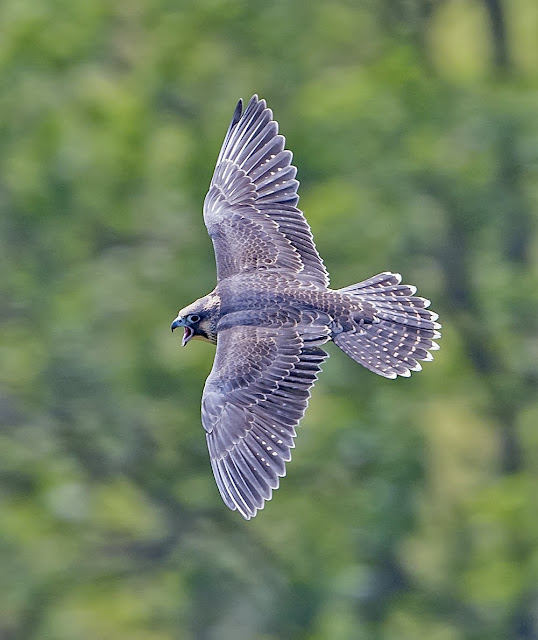
I prefer taking bird photographs in natural surroundings and the cliffs at Scarborough provide a great backdrop, particularly for flight shots.  But Scarborough is two and a half hours drive for me and you do need to be there in the morning to get the light on the right side of the cliffs. So Malham, which is only one and a half hour's drive from my home now gets my vote for this type of photograph, especially when the sun is shining like it is at the moment.  And better still, you can easily get at eye level and above the birds to get some overwing shots, instead of being underneath them all the time as at most other places.


This year two Peregrine chicks have fledged successfully and they are happily flying around the area around Malham Cove although still under the watchful eyes of their parents.  At times the huge ampitheatre which is the Cove echoes with the sound of the birds screeching for food - a truly wonderful sound.


The chicks are brown compared to their parents' grey colour and so are quite easy to spot once you have got your eye in.  There can be long waits between each flying session when the birds just sit perched on a rock ledge or in a tree and I was there for over six hours to get these shots with less than half an hour total flying time.


So here's a piece of trivia to end on which to end this post. The Peregrine's nostrils were the inspiration for part of the design of modern day jet engines. The air pressure from a Peregine's 200mph stoop or dive could easily damage the bird's lungs so the opening of the nostrils contain small bony tubicles which protrude slightly and which guide the air entering them reducing the pressure and shock waves created.


This enables the bird to breathe whilst in a stoop by reducing the change in air pressure. You can see the tubicles in the photo directly above. Jet engines were later developed with a cone in them just like the Peregrine's nostrils which allows the air to pass through at great speed in a very similar way. Once again, a human invention inspired by nature.


As I mentioned earlier, this is now the 'go to' place for all my Peregrine shots, and next year I'll be getting there even earlier the year to watch the events fully unfold.  But I better let the bird have the last word.