I fell in love with Spurn last year when I went to see the Siberian Accentor, a UK mega rarity. I'd never been before and I knew that, if I were to miss out on the Accentor, there'd still be plenty of other birds to see, so it was worth going for it. Well I did see the Siberian Accentor and a lot of other great birds too, but I didn't expect to be going back so soon. However, with a long-staying juvenile female Pallid Harrier still showing from before Christmas and with the prospect of good weather, I decided to make another trip today.
This time I didn't go alone though, as I'd been planning to take my Leigh Ornithological Society friend George Pike out on a birding trip for a while, since he and his lovely wife Angela have ferried me about quite a few times on previous trips. So off we set at 7:30am to make the 2.5 hour trip to the east coast. Despite George being nearly 10 years older than me, we think alike on many subjects and we had a good chat about many of them on the way.
I'd planned finding the bird's location using a variety of sources, including reports off the internet, Google Maps and an email from Martin Standley whose blog (East Yorkshire Wildlife) I came across in researching the bird. Martin has taken some excellent photos of the Pallid Harrier as well as Hen Harriers nearby, so I contacted him and he very kindly gave me some directions.

Amazingly George hadn't actually been to Spurn before, and so I decided to show him around the parts I knew with the secondary target bird of a 'Black Brant' Brent Goose which had been showing regularly in recent days. One of the other birders had got a pager report saying that it was showing in the field facing the car park for the Kilnsea Wetland Reserve, so that's where we headed for. On arrival that birder wasn't there, so we assumed that the Brent Geese had flown, which indeed they had. There were quite a few Curlew and some Redshank in the flooded field where the Brents had been, but no geese.
 |
| Brent Geese on the Humber Estuary outside the Crown and Anchor Pub, Kilnsea |
After chatting to another birder on the car park who told us about a female Scaup on the Wetlands Reserve which we decided to miss out, George and I set off for the Crown and Anchor pub, where there is a good view over the Humber Estuary and it was here that we first connected with the Brent Geese. On the way I pointed out the new Spurn Observatory which is now based in a normal house as well as a small motorhome campsite which I'd discovered on my last visit. There were a few other waders including Turnstones about, and the Brent Geese gradually swelled in numbers as more of them swam up the estuary. Eventually there must have been about 50-60 of them, but as they were on the water we only had the larger white neck patch to use for identifying it, and we could't pick it out.
 |
| Turnstone in the mud outside the Crown and Anchor Pub, Kilnsea |
From here I took George down to the Blue Bell Cafe car park from where I picked out two distant Red-throated Divers on the sea, as well as some Gulls and unidentified ducks. We then went on to the Canal Scrape Hide in the hope of seeing a Jack Snipe, but it didn't materialise. It was quite disappointing really as last time I'd been here I had good views of a Water Rail, drake Gadwall and several other common ducks - today there was only a pair of Mute Swans, some Coot, a Moorhen and three Magpies. After to talking to yet another birder, we decided to walk round to the canal bank which forms part of the famous 'Kilnsea Triangle' to have a look over the marsh towards the estuary. Here we saw some distant Dunlin, Knott, Shelduck, Curlews and Redshank.
 |
| Black Brant Goose in amongst the dark-bellied Brent Geese in a field just outside Kilnsea |
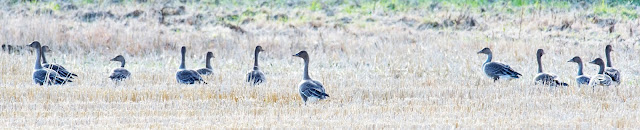
After having a bite to eat, we decided that we'd now go back and put some time in at Welwick Marsh to try to track down the ellusive Pallid Harrier. On the way back we came across a field of 300-400 dark-bellied Brent Geese, so we just had to stop for a look. I'm really glad that we did, because after five minutes or so I'd located the 'Black Brant' Goose, which luckily was feeding right at the front edge of the herd giving us great views.
 |
| Black Brant Goose in amongst the dark-bellied Brent Geese in a field just outside Kilnsea |
The rare vagrant Black Brant is a race or subspecies of Brent Goose which is found in North America, Canada, Alaska and Eastern Siberia whereas the dark-bellied Brents are from Russia and Western Siberia. Who knows where this one joined the flock as they migrated through the Baltic to the UK?
 |
| Brent Geese taking off from a field just outside Kilnsea |
After having good views of them for around ten minutes, the flock suddenly took off. I don't know what spooked them, but I don't think it was me.
 |
| Merlin on Welwick Marsh |
So now we went back to Welwick Marsh and rejoined some more birders all anxiously looking for star turn. We spent a good ten minutes or more discussing a distant bird perched on a log. The bird looked quite different as the light changed and we went though Peregrine and a couple of Harriers before eventually settling on Merlin.
 |
| Pallid Harrier on Welwick Marsh |
There were also at least two Little Egrets on the Marsh and several Carrion Crows. And then it appeared from from the right side of the Marsh - we had a distant glimpse of the Pallid Harrier before it went down into the vegetation. Wth the views we had I couldn't be sure what type of Harrier it was, particularly with Hen Harriers being in the area too, but another birder who had seen them before was very confident that this was our target bird.
 |
| Pallid Harrier on Welwick Marsh |
 |
| Pallid Harrier on Welwick Marsh |
Update: I've since had it confirmed that this is indeed a juvenile female Pallid Harrier, having four 'fingers' on narrower wings rather than the Hen Harrier's and Montagu's Harrier's five 'fingers' on broader wings, and having a dark neck collar compared to the Montagu's light neck collar. It also has a rufous breast rather than the Hen Harrier's streaked rusty yellow breast.
 |
| Pallid Harrier on Welwick Marsh |
It gave us several distant fleeting views, and sat for quite a long time giving us a 'head and shoulders' view but it never came close. The best photo I got was the very last one I took, but it's nothing to write home about. Good enough to tick though!
 |
| Short-eared Owl on Welwick Marsh |
A Short-eared Owl appeared next quartering the marsh, and we hope that it might just fly over the Harrier and send it up, but unfortunately this didn't happen. A second Owl did appear a little later however and there was a brief moment of apparent conflict between them, but it didn't last long.
 |
| Short-eared Owl on Welwick Marsh |
We stayed a little longer, but the light was dying fast and so George and I decided to head for Sunk Island where there is a set-aside field that Hen Harriers have been seen in regularly - at this time we thought that we might just see them coming in to roost. The route was a little uncertain and we were never quite sure that we were going in the right direction, but we went past a few of the landmarks which people had mentioned, such as the church and a bridge, so we persevered.

After about 20 minutes the light had dropped even more, so we decided it was time to make the 2.5 hour journey home. We set off knowing we'd seen our target birds here and had enjoyed a good day out in great weather.
Thanks George, we must do it again sometime!