Sunday, 20 September 2020

A Short Trip to the Whisky Isle of Islay


For our first extended motorhome trip in our recently acquired van we decided to go to Islay in the Inner Hebrides. Islay is well-known for its birds but due to Sarah's holidays we were going in between seasons really - too early for the influx of winter geese and other migrants returning from their breeding groups further north and after many of the summer visitors had left. Not to worry though, my recent interest in night sky photography and whisky gave me another reason for going - the hope of some dark skies and visiting some of the eight single malt whisky distilleries for which the island is world famous.


On the trip we saw a few birds but the only 'speciality' bird we found were four Choughs on the Ardnave headland near Loch Gruinart. We heard them long before we saw them as they make quite a different sound to other corvids. They were mainly feeding by digging in the sandbanks for insects.


The birds were quite mobile and none of these shots are particularly sharp - not having been birding for ages, I needed to get used to the weight of my camera and long lens again. It's funny how quickly you can get out of practice.

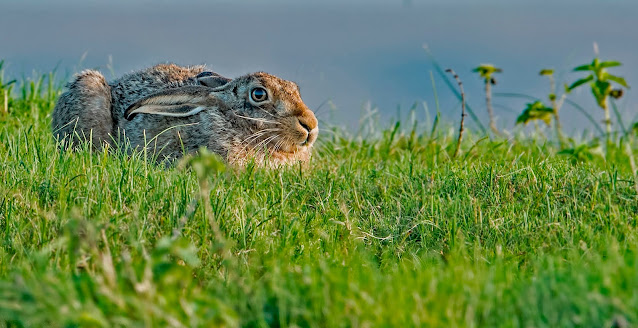
I also stumbled across this lovely Brown Hare which was laying low in the grass until it saw me - then it shot off into the distance never to be seen again.


It would have been rude not to help out the local economy whilst enjoying our short stay on Islay.


Friday, 4 September 2020

Red-backed Shrike in West Midlands

Today I called in at Sutton Park NNR in the west Midlands to see an adult male Red-backed Shrike on the way back from Cheltenham.


Monday, 31 August 2020

Bank Holiday Treat

Well, this was a great Bank Holiday surprise. I never thought I'd see a Wryneck in Greater Manchester, let alone have it giving such good views. This bird has been on my 'most wanted' list for sometime now and I was sure that I was going to need to travel to the Spurn area on the east coast to see one. 


So it was great to finally get this one so close to home and to watch it with a great bunch of people. Life and Greater Manchester tick.


Starting to get my birding mojo back now - roll on Islay in a couple of weeks!

Thursday, 6 August 2020

A Celebrity Bird appears in Derbyshire

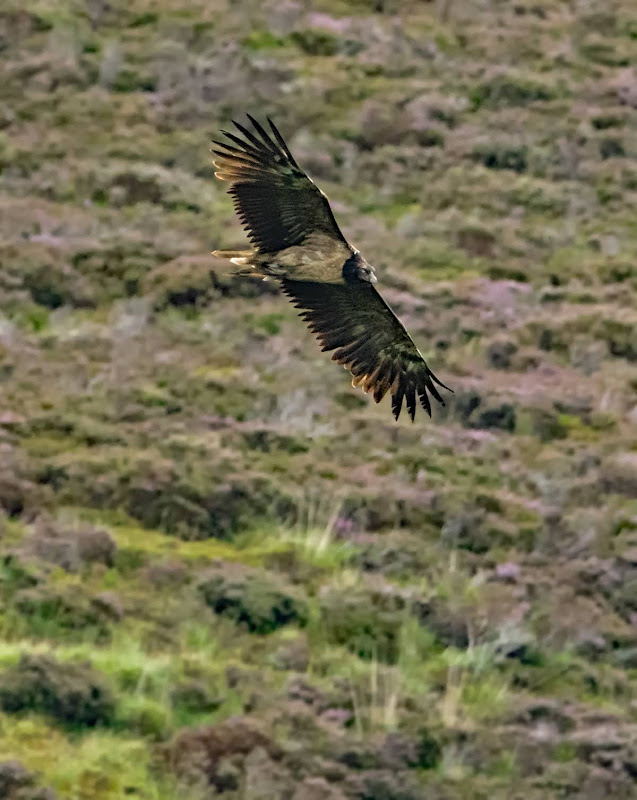
After after four month break, I returned to serious birding activities yesterday with a trip to see Derbyshire's celebrity star, the Lammergeier or Bearded Vulture. I spent over 12 hours in the valley above Crowden with fantastic company as we hoped to get some photos of this beast of a bird.  

My best shot was taken at 7:24am after the mist had cleared to reveal the bird at one of its current roost sites. After that all I had were distant shots as we watched it riding the thermals in a number of places. I'll post a few more later (jobs to do today) but I had to get one out there after a great day out. 

All these shots were taken from the Pennine Way footpath along with 10 other birders and numerous passing hillwalkers.

Sunday, 9 February 2020

Back to the Day Job

You may have noticed a little bit of lunar and night sky photography creeping into my blog recently as I slowly climb the very steep learning curve that is astrophotography.  Well that's my night job and so now I'm going back to the day job which is birding and bird photography. Ive got a few posts (listed below) to catch up on which I'll hopefully do over the next few days.  But to kick off I'm just posting four shots of some raptors I saw on the Wirral yesterday.


To do:
  • Siberian Stonechat - 5/1/20
  • Long-billed Dowitcher - 12/1/20
  • Purple Heron - 15/1/20
  • Barn owl - 15/1/20
  • Siberian Chiffchaff - 15/1/20
  • Short-eared Owls - 27/1/20
  • Starling Murmuration - 6/2/20
  • Rough-Legged Buzzard - 29/1/20
  • Wirral - 8/2/20

Wednesday, 18 December 2019

Early Riser

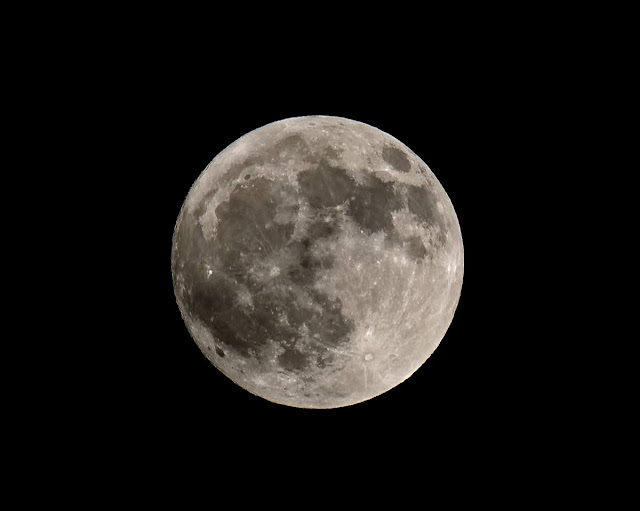
I couldn't sleep last night so, as the hazy moon was shining through my window, I got up at silly o'clock this morning and waited for a break in the clouds. Eventually it came and I took some shots of this waning gibbous moon. This one has turned out to be one of the sharpest moon photos I have ever taken.

But as the sky cleared I decided to also have a go at some tracked shots and I was quite pleased to get my first image of the Ring Nebula (Messier 57) even though it's far from perfect.  The Ring Nebula (is a planetary nebula in the northern constellation of Lyra. Such objects are formed when a shell of ionized gas is expelled into the surrounding interstellar medium by a star at in the last stages of its evolution before becoming a white dwarf.

This is just a single tracked shot taken with a 500mm f/4 lens plus 1.4x teleconverter on a crop sensor camera - 700mm ISO 640 f/8 @ 3 minutes. Yes, it really is that blue.


My next target was Bode's Galaxy (Messier 81) and the Cigar Galaxy (Messier 82) which can both be imaged in one shot - can you guess which is which from the photograph below?

Bode's Galaxy is a spiral galaxy about 12 million light-years away, with a diameter of 90,000 light years, about half the size of the Milky Way, in the constellation Ursa Major. Due to its proximity to Earth, large size, and active galactic nucleus (which harbours a supermassive black hole), Messier 81 has been studied extensively by professional astronomers.

The Cigar Galaxy is a starburst galaxy approximately 12 million light-years away in the constellation Ursa Major. A member of the M81 Group, it is about five times more luminous than the whole Milky Way and has a centre one hundred times more luminous than our galaxy's centre.

Next onto the Hercules Globular Cluster (Messier 13). This globular cluster consists of several hundred thousand stars in the constellation of Hercules. It's sometimes called the Great Globular Cluster in Hercules.

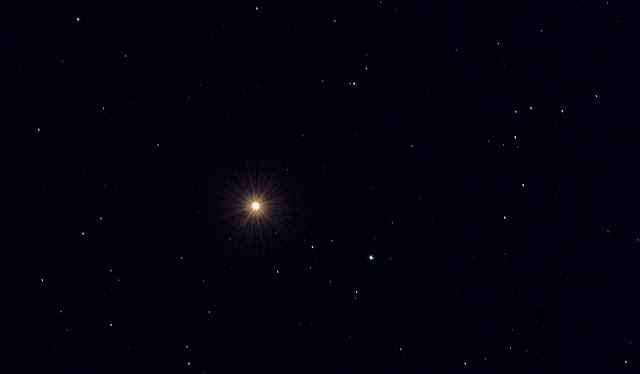
Arcturus (below) is a red giant star in the Northern Hemisphere of Earth's sky and the brightest star in the constellation Boötes (the herdsman). Arcturus is also among the brightest stars that can be seen from Earth. Astronomers say Arcturus will end up as a white dwarf at the end of its life.


Vega (below) is the brightest star in the northern constellation of Lyra. This star is relatively close at only 25 light-years from the Sun, and, together with Arcturus and Sirius, one of the most luminous stars in the Sun's neighbourhood. It is the second-brightest star in the northern celestial hemisphere, after Arcturus.

Vega has been extensively studied by astronomers, leading it to be termed “arguably the next most important star in the sky after the Sun”. Vega was the northern pole star around 12,000 BC and will be so again around the year 13,727. It was one of the first stars whose distance was estimated through parallax measurements.


And finally a quick snap of the Whirlpool Galaxy and friend (Messier 51). The Whirlpool Galaxy was the first galaxy to be classified as a spiral galaxy. It lies in the constellation Canes Venatici where it is interacting with a smaller companion galaxy. Sometimes the designation M51 is used to refer to the pair of galaxies, in which case the individual galaxies may be referred to as M51a and M51b.

But by now it was starting to get light so I struggled getting a decent image of these two galaxies. This is definitely a deep sky object to which I will be returning.


Individually, some of my images don't look much, but when viewed as a collection they start to show how varied and immense the universe really is. And boy do the constellations look different so early in the morning!

Wednesday, 11 December 2019

Almost a Full Moon!

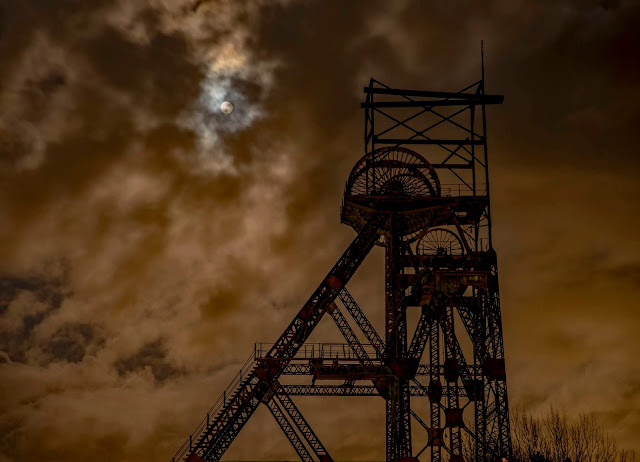
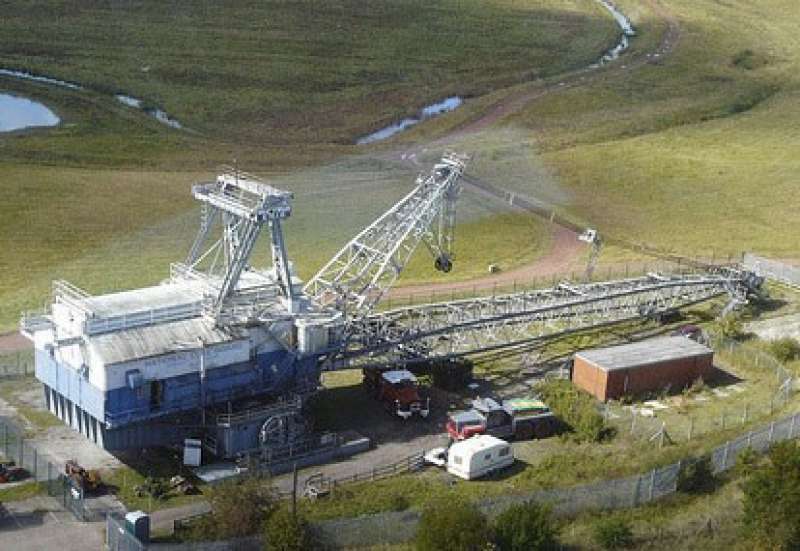
It has been a longhand ambition of mine to get a photo of a full moon near or behind the pithead winding gear at Astley Green Colliery.  I have tried several times but it didn't take long to realise that I'd need to do a blended composite of two images to get the correct exposure and desired effect.

Astley Green Colliery has the only surviving headgear and engine house on what was the Lancashire coalfield. The headgear is made from wrought iron lattice girders with rivetted plates at the joints. It has two large and one small wheel mounted at the top. It is nearly 30 metres (98 ft) high and was built by Head Wrightson of Stockton-on-Tees and completed by 1912.

In the winding house there is a twin tandem compound steam engine made by Yates and Thom of Blackburn who supplied 16 Lancashire boilers. Its engine house has the largest steam winding engine used on the coalfield. The 3,300 horse power twin tandem compound engine was built by Yates and Thom in Blackburn.


When I got home I decided to get some (almost) full moon shots from my front garden before the clouds rolled in again.


Sunday, 1 December 2019

L.O.S. 'Decide on the Day Fieldrip' at St. Aidan's RSPB

The L.O.S. had decided to have one fieldtrip this year where we hadn't planned where to go in advance, allowing us to take the weather conditions and any recent sightings into account before setting off. Well, the weather was set to be atrocious on the western side of the UK today and so heading east was the only real choice if we were to stay dry and have a chance of a decent day. St. Aidan's RSPB in west Yorkshire quickly became the destination.


We hung around until the moon came out at around 4pm in the hope that we'd see some of the Short-eared Owls that are currently here, but unfortunately none of them showed up for us today.


A total of 51 species were seen or heard during the day, so not a bad trip at all.

Monday, 18 November 2019

My Latest Lifer

Here's a photo of my latest lifer - a Hume's Leaf Warbler taken a Bempton Cliffs RSPB.