Friday, 18 May 2018

Kent Trip Day 2 - Dungeness RSPB and Rye Harbour NR

On my previous visit to Kent in February I had intended to go to Dungeness RSPB which is in the south-east corner of the county about an hour away from my son's house in Chatham.  However, there was so much to do in the North Kent area that I didn't find the time to go, so it was always going to be a key target site for this trip and today was the day that I planned on spending a whole day there.  I'd been told by several people that it's a weird and wonderful place, and they weren't wrong with its gravel landscape and heathland vegetation.  It's ideal for many types of scrubland bird, not to mention the exhausted migrants landing here from flying over the channel.


My first good bird at Dungeness was one I was looking to year tick for #my200birdyear list. Even though it's distant this is the unmistakable sight of an Egyptian Goose. There were at least three adult birds and one chick present and, as this introduced bird is now a self-supporting UK breeding species in the wild, it counts for listing purposes.  There were also two Little Gulls on the islands and although I didn't get a really good look at them, I'm still counting those too!


After this initial delight I didn't see much else at Dungeness today.  Yes, there was a distant Great White Egret and a couple of equally distant Marsh Harriers, but none of the promised Hobbies or Dartford Warblers. The blazing heat had probably cause a lot of the birds to hunker down and wait for the cooler hours to come out and start feeding. So the rest ofd the birds mainly consisted of a few Curlews and Cormorants, some Common Gulls and a few Tufted Ducks and Mallards and some Common Terns - not really much to write home about. However, whilst I was in the superb 'new' Visitor Centre some very helpful local people gave me a few pointers about places to go and the name of Rye Harbour came up more than once.


 Rye Harbour (that's the name of the town which is next to but separate from Rye) is on the south coast of East Sussex and only a short distance westwards along the coast from Dungeness RSPB.  After a day of limited photography opportunities at Dungeness, it was nice to finally have something to shoot at here. It began with Avocets, some already having young followed quickly by Golden Plover, Ringed Plover and Dunlin.  And then there was a Cuckoo and another Egyptian Goose.


There were some Common Terns nesting very close to one of the hides and a Redshank feeding.

It's a little gem of a place that I'd never even heard of with a variety of habitats particularly for waders but also for Common, Sandwich and Little Terns (there will shortly be a breeding Little Tern colony here) and Cuckoo. It's a place that needs at least half a day and better still a full day to visit over the tide, so I hardly did it justice in the few hours I was here this afternoon.


Finally, to finish it off, this Herring Gull was loafing on the grassy slope in front of my car.


P.S. Of course as often happens, on the following day some action took place at Dungeness RSPB when a Hoopoe and a Bee-eater appeared. Grrr!

Thursday, 17 May 2018

Kent Trip Day 1 - Nightingale Walk at Cliffe Pools RSPB

Today was the start of my long five-day weekend down in Kent, visiting my son in Chatham and also calling in at a few birding sites each day.  To be honest, I was just looking for an excuse to take some photos of Colin the Thursley Cuckoo in south-west Surrey, but if I was going to travel four hours down from the North West to see him, I might as well combine it with some other locations too.

On my previous visit to Kent I had found out that the county is a bit of a hotspot for Nightingales and that there were several walks being organised by the RSPB at various places in May.  The last one was at Cliffe Pools RSPB in North Kent, and was ideal being just 30 minutes or so from where Robert lives in Chatham.  So that set the time and date for my visit - 7pm on Thursday 17th May.

I arrived at Cliffe Pools RSPB at around 5pm with the aim of having a look round before the start of the walk.  The air was full of Swifts and the pools were alive with the sound of Black-headed Gulls.  I found a Whitethroat, a few Ducks and some Common Terns on my walk round, but not much else.


At around 7pm on the car park I met up with the RSPB's David Saunders who was leading the walk  There was an excellent turnout of around 20 people, not including the RSPB staff.  Just before we set of a pair of Mediterranean Gulls flew overhead and a Kestrel was hovering over a nearby field. We walked up and down one particular stretch of causeway between two pools and, after a slow start, eventually had several very good bursts of song.  Seeing the birds was a totally different matter however, and all we really got was a few moving branches.

Later, on the way back to the car park I did manage to get a very brief glimpse of a whole Nightingale - it was a fleeting but unmistakable view as it flew up and out of the bush where I was listening to it sing.  By now I had already decided that it was a little too late in the year to be trying to see these wonderful songsters - in mid to late April or the first week of May, with fewer leaves on the trees, there would be a far better chance of seeing them.  So that would have be a target for next year.

Monday, 14 May 2018

Day 4 - Scarborough, the Humber Bridge, Far Ings and Blacktoft Sands RSPB

So today was the last day of my mini-break to east Yorkshire and I had a few places in mind for visiting on the way home. The first place wasn't actually on the way home, as Scarborough is 30 minutes in the wrong direction from my campsite.  But I'd always intended to go there as I wanted to be photographing the Peregrine Falcons on the cliffs along Marine Drive in the morning when the sun shines in exactly the right direction.

To be continued ...

Sunday, 13 May 2018

Day 3 - L.O.S. Fieldtrip to Bempton Cliffs RSPB

In the weeks before I set off on this mini-break to east Yorkshire, I'd realised that not many people were going to attend the final L.O.S. fieldtrip of the season today. May is a time when people go on holiday if they can to avoid the higher summer prices and the family crowds when the schools have broken up.  It's also a time when people arrange their special events such as weddings and christenings. We still had at least six people going in the last few days leading up to the trip, but a succession of messages telling me people weren't coming turned my mind to cancelling it altogether.  The weather forecast and the distance had perhaps put them off going.

However, one person, John Preston, was faithful until the end and never wavered in his desire to come.  He even volunteered to meet people with a map and directions at the usual place on Doctors Nook car park in Leigh, mainly because I wouldn't be there as I was already in Flamborough.  So I was consoled to the fact that there would be just the two of us at Bempton, and naturally I was very pleased to discover on the car park there that young birder Kristian Wade had also turned up and come with him.  Kristian went on our previous trip to Bolton Abbey last month, and he obviously wasn't put off by the age profile of the L.O.S. membership!

To be continued ...

Saturday, 12 May 2018

Day 2 - All aboard the Yorkshire Belle

As my boat trip along the sea cliffs at Bempton didn't start until 4:30pm today, I more or less had the whole day to do some exploring around the Flamborough area.  This was useful because I could get the lay of the land in case anyone wanted to extend their L.O.S. fieldtrip visit tomorrow.  It also meant that I didn't need to get up very early and, after a very pleasant evening at the campsite, followed by a shower and then breakfast in my motorhome, I only left at around 9:15am.

I started at Flamborough North Landing, before visiting Thornwick Bay and finally Thornwick Pools. The scenery here is fabulous, with white chalk cliffs carved into stacks and caves by the action of the waves on it over hundreds of years.  It's a geographer and geologist's paradise and indeed I first came here when I was studying for my B.Sc. Honours degree at Manchester University in the 1980's.  Unfortunately I didn't bring a lens suitable for landscapes with me and so I had to make do with photos taken on a mobile phone.

To be continued ...

Friday, 11 May 2018

Day 1 - St. Aidan's RSPB and Fairburn Ings RSPB

The final L.O.S. fieldtrip of the season is to the fabulous Bempton Cliffs RSPB nature reserve in east Yorkshire. Although I've travelled there and back in a single day on many occasions,  as I've got my motorhome back on the road I've decided to spend a few days there and tie it in with the RSPB boat trip from Bridlington Harbour.

So, with my tickets for the boat trip booked online,  today I set off for Grange Farm caravan and motorhome site in the Flamborough area, which is equidistant between Bridlington and Bempton.  But I was never going to travel all that distance without stopping somewhere on the way first, and the RSPB reserves at St. Aidan's in Swillington and Fairburn Ings seemed to be as good as anywhere for  visit, without needing to go too far off track.

My main and only target at St. Aidan's RSPB was to get some shots of the Sand Martins which I'd seen just starting to gather on my last visit in April.  A man-made nesting bank has been created on one of the pools and that's where I was heading.  However, I couldn't resist having a quick look for  one of the resident Little Owls on the huge coal dragline parked permanently outside the new visitor centre there.  Unfortunately I didn't see them today, but I did get this nice Kestrel instead.


To be continued ....

Thursday, 12 April 2018

Dumfries and Galloway Trip - Day 3a

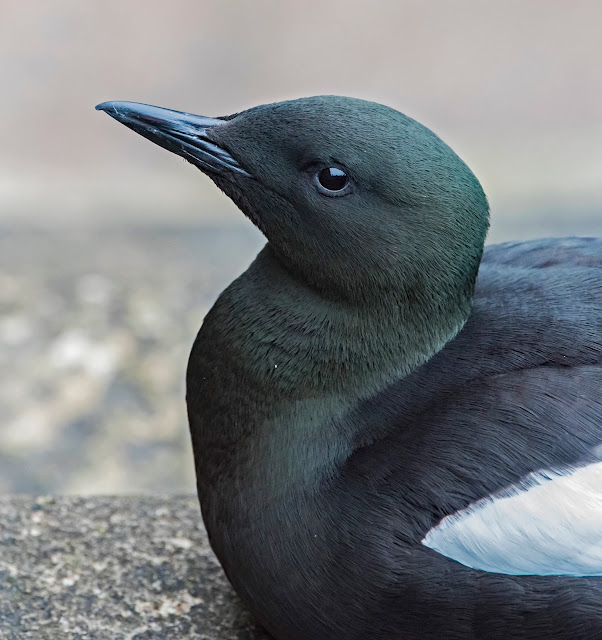
Day 3 on my mini-birding trip to Dumfries and Galloway saw me venturing to the west-coast of the Rhins of Galloway to the pretty little harbour town of Portpatrick.  Ever since my first visit to this wonderful part of southern Scotland I have been wanting to see the famous Black Guillemots or Tysties which are well-known for nesting in the harbour walls here, and today didn't disappoint although the light could have been better.


I took a cross country route through some marvellous scenery for my journey and I briefly stopped at an ancient stone circle known as Torhouse before arriving at Portpatrick.


I spotted a distant bird in the harbour mouth almost as soon as I got out of the van and so I hurried up to the lighthouse end of the harbour to discover it was a Cormorant.  But after only a few minutes two or three Black Guillemots flew low over the water from the open sea before landing in the harbour proper and I immediately realised I was at the wrong end!


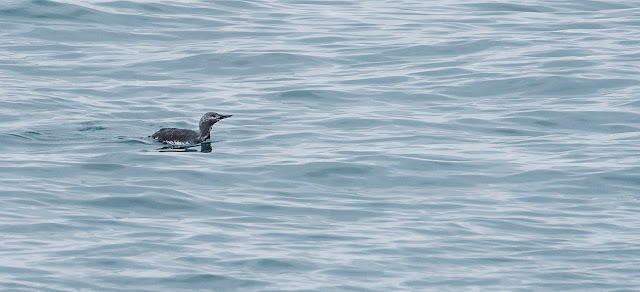
So I turned my binoculars on the open sea to look for Divers and was amazed to find a distant but definite Red-Throated Diver almost immediately. I went up to the top car park to get a photo and here I met another motorhome owner and his wife. They were a very nice couple and I chatted with them for some time about where they'd come from (Motherwell) and whether it was possible to overnight here and other such motorhome talk.


After this I went back to the van, picked up my tripod and headed off to the north end of the harbour where most of the Black Guillemots had congregated.  The harbour echoed with their calls and many were sitting inside holes in the harbour wall where they will eventually nest.


I spent a good two or three hours here trying to get flight shots of the birds coming from the sea and up to their nest holes, but the light really wasn't good enough to get the detailed shots I wanted.  However it is a place to which I will return on a sunny day because the potential is enormous.

As well as the Tysties there were also Pigeons and Jackdaws nesting in the harbour walls and I managed some slightly better shots of these birds when the sun put in a very brief appearance.


Wednesday, 11 April 2018

Dumfries and Galloway Trip - Day 2

My destination today was Threave Castle to see the Ospreys which nest close by each year and with a bonus of seeing the Peregrine Falcons which nest in the castle itself.  I made the mistake of going to Threave Gardens first but whilst I was waiting for the visitor centre there to open, I had the feeling that it wasn't the right place as the castle ruins are some way from the gardens. So off I set in search of the castle and the birds.

On arriving at the castle location I had a nice chat with Louis in the visitor centre and he gave me a good overview of the site and where things were. Luckily I'm a National Trust for Scotland member and so I can get in to the castle (which requires a short boat trip over the River Dee) to see the Peregrines free of charge.

But my primary target was the Osprey nest and so that's where I went first. I stayed here around an hour and a half and for a long time all that could be seen was the top of an Osprey's head rising slightly above the top of the nest.  I went for a walk along the path to the first hide and on my way back a second bird came back to the nest and perched on the edge.  The sitting bird than left and returned after about 10 minutes with a fish.


Although nearer than some nest sites, the Ospreys are quite distant here and so great photos are not really possible.  The gloomy weather also didn't help, so after taking a few record shots I decided to head for the Peregrines at the castle.  When I arrived at the boat, the warden piloting it asked me if I was the National Trust Photographer, probably because of all the gear I was carrying on my trolley.  I had to tell him 'no', but that I wished I was!

After I got off the boat, a second warden called Malcolm took me straight to a place where we could see one of the Peregrine's sitting on an inside window ledge on the thick north-facing wall. These shots were all taken through a south-facing window looking across the castle to the bird on the opposite side.  I'm so glad I took these as after about five minutes the bird went out of view as it walked deeper into the castle walls.  And for a few of these five minutes I turned into a warden myself, showing people where they could see the bird as well as the shots on the back of my camera.


Later in the afernoon I considered going to the Red Kite Feeding Station at Bellymack Hill Farm in Laurieston, but as the weather was still gloomy and I'd seen Red Kites being fed earlier this year, I decided just to go to the Ken-Dee Marshes RSPB site to see the Greenland White-fronted Geese.

I found about twenty of the geese associating with some Icelandic Greylag Geese in a field close to the road.  I had a good look at them though my binoculars, but unfortunately they spook very easily and whilst I was getting my camera from the back of my motorhome they flew off, even though I didn't even get out of the van.

After parking the van I walked up to the Goose Viewing Platform which overlooks the fields where they are most commonly seen feeding but apart from a few Greylags, Mallards, Canada Geese and the odd Red Kite here and there, there really wasn't much about, so no photos at all I'm afraid. Well at least I saw them earlier.

From the Ken-Dee Marshes I decided just to head for my next campsite near Wigtown as it was about an hour's drive from here.

Tuesday, 10 April 2018

Dumfries and Galloway Trip - Day 1

After a lovely and thankfully uneventful drive up the M6 in my old motorhome to Dumfries, I arrived at Caerlaverock WWT at about 3pm.  Yes, it was a bit late, but I managed to get to see my first target birds, the Barnacle Geese.


Almost the entire Svalbard population of around 35,000 Barnacle Geese overwinter here on the Solway Firth every year, and they are quite a spectacle to watch both flying and feeding.  Unfortunately, by this time of year many of them have returned to Svalbard, but there were at least 500-600 of them present at Caerlaverock today.


The weather was rather grim and so my photographs aren't great and I only noticed this odd looking goose once I had got the shots onto my computer.  At first I thought it was a blue morph Snow Goose but on closer inspection it seems to be a Barnacle/Snow Goose hybrid or something similar.  Further investigation has revealed that it is quite well-known at Caerlaverock and returns every year with the Barnacles.

I also saw lots of Shoveler. Teal, Wigeon a few Black-tailed Godwits and Mute Swans, but no Whooper Swans which had probably all left for Iceland now.  On the woodland trail I saw Blue Tit, Great Tit, Robin, House Sparrow, Chaffinch, Greenfinch, Collared Dove and Woodpigeon but suprisingly I didn't see any Yellowhammers although I did think I heard one calling near the car park.

My first campsite was at Rockcliffe on the other side of the Nith Estuary and so to get there from Caerlaverock I had to go through Dumfries to cross the River Nith.  A programme about rivers on TV had recently reminded me of the lovely old sandstone bridge there and the weir where Goosanders are regularly seen fishing, and so I decided to make a quick stop there in spite of the light dropping quickly.  The first bird that I noticed at the weir however was this one:

In the fading light I thought it might have been a Yellow-legged Gull when I took the photograph, but on looking at it on the computer I realised it was a Lesser Black-backed Gull.

More to come ....

Monday, 9 April 2018

Motorhome Woes

I've not had a lot of luck with an old 1997 Peugeot Autosleeper Symphony motorhome which I bought primarily for going birding in about three years ago.  A succession of faults and work needed due to MOT failures has meant that I've only overnighted in it four times since buying it and then only for a maximum of two nights. My best trip has been to the Farne Islands last July where I used it at a campsite at Seahouses, but in truth it's been a very poor purchase due to it's condition and I stand to lose quite a lot of money if I try to sell it.  I really should have had it looked at by someone before buying it and it's quite clear now that the guy who sold it to me was a crook, especially as he was later prosecuted and convicted for faking vehicle documents.  But it's easy to be wise after the event.

It failed it's MOT again in April this year and so the question was, do I take the (very big) hit and sell it, or do I pour some more money into it and get it back on the road?  Well, my reckoning was that I wasn't going to be able to sell it for anything worthwhile without an MOT so I had to get that sorted first.

And then I've decided that I'm going to use it at least until midsummer in trying to do five target trips - Dumfries and Galloway, Norfolk and Suffolk, Spurn, the North East Coast, and Anglesey.  Depending on how these go I may also venture further into Scotland to go up to the Cairngorms and the Black Isle.  I really should try to sell it then with at least six months left on its MOT.

That's the plan for now, let's see how it goes starting with a trip to the beautiful Dumfries and Galloway, target birds of Barnacle Geese, Ospreys, Peregrines, Black Guillemots, Brent Geese, Scaup and Divers.

Thursday, 5 April 2018

The Worst Kept Secret Location in Yorkshire

Black-necked Grebes in West Yorkshire this week.  More text to follow ....


Tuesday, 3 April 2018

Three Sisters Nature Reserve in Ashton

Just about the worst place to try to photograph Tawny Owls. First of all a very steep, wet, muddy and slippy slope covered in brambles, rotten stumps and ash whips and then a high up bird that is obscured by branches, leaves and which sleeps most of the time! That's Three Sisters Nature Reserve for you!


But at least I got it!

Monday, 2 April 2018

Publish And Be Damned!

Yay, I got a short and hopefully humorous item with a photo of this January's Desert Wheatear at Whitby printed in this month’s BirdWatch magazine. They added the title and the first paragraph, but that's OK.


Here's the original photo:


And here's the pie and mash!