Today Sarah and I went out to the
Bolton Abbey Estate in
Wharfedale in search of Redstarts and Flycatchers.
Strid Wood is owned and managed by the Estate and is a Site of Special Scientific Interest (SSSI).

It is one of the largest remnants of ancient semi-natural sessile oak woodland in the Yorkshire Dales National Park and the wood is set either side of the
River Wharfe as it runs through a steep-sided valley. The wood gets its name from
The Strid, a natural wonder, where the rocky river banks suddenly narrow forming a channel, forcing the water through at great pressure.
I was here last year in May on an L.O.S. field trip, and as we walked from the free Barden Bridge car park across the field I told Sarah what I had seen then - a Common Sandpiper, Grey Wagtails, a pair of Oystercatchers as well as hearing a Cuckoo calling. So it was really strange to see each of these again almost exactly in the same places as last year and just as I pointed out the previous location of each bird!
The first bird we saw was a
Common Sandpiper flying low over the water before landing on the opposite bank near some Mallards and their chicks. As you can see, I only got a quick record shot before it flew off.
Next there were two
Grey Wagtails catching flies above the pebbles on the nearside bank. A single Oystercatcher seemed to be settling down on a nest in a fenced off field (later I saw six of calling as they flew past). And then we heard the
Cuckoo - after a quick look through my binoculars I located it sitting on the wires near the farm high up the hillside before it flew off. A great start to the trip!
It was really nice to see some
Sand Martins which were nesting on both sides of the river bank here. They were busily flying back and forth over the river and then into their nest holes, but they were so small and quick I couldn't get a decent flight shot. The light was unfavourable for nest shots from this side of the river, so only record shots again I'm afraid.
My first real photo opportunity came as we were looking for the Dipper at the nest site it had last year by the next bridge. It wasn't the Dipper (which, very surprisingly, I didn't see all day) but another
Grey Wagtail sitting in a Hawthorn bush growing out of the stonework, close to where the Dippers had nested last year. I was later told that the Dippers had fledged and a second brood was to be expected soon.

Sarah and I sat down on the stone neck close to the bridge to survey the river for Dippers, but all were saw were Mallards and Grey Wagtails. This area was also the spot where I had seen Redstarts last year, so my attention was quickly turned to scanning the trees with my binoculars. Whilst doing this I soon spotted another couple of bird photographers on the opposite bank who had their attention focussed on the fence posts underneath a line of trees. So, leaving Sarah munching away on an apple, I crossed the bridge to have a word with them and learnt what I was expecting to here - some Redstarts were about here.
As it turned out, one of the photographers recognised me from last year and he even knew my name! Well, my memory for names is terrible, mainly because I meet so many people in various places around the country, and so I couldn't remember his, although I slowly recalled our meeting as we chatted. This was Martin Byron and he'd brought some live mealworms to entice the Redstarts out of the trees and down on to the posts to have their photos taken. And every now and then that's what happened.
The other guy was called Tony and the three us had a good chat whilst photographing the male and female Redstarts as they briefly came down to see us every now and then. Their main food here seemed to be green caterpillars off the gravel public footpath underneath the trees. I assumed that these were falling off the tree branches which overhung the path.

The public footpath was the main problem with this location as it was quite narrow at this spot and there was a lot of traffic. But just about everyone who went past was interested in what we were doing and were very pleased to see the photos we were taking as well as learning a little about the birds.
This is the point where Sarah went off for her scenic circular walk through Strid Wood and along the banks of the River Wharfe around the Bolton Abbey Estate. I'd done most of this on my previous trip so I knew how nice it was.
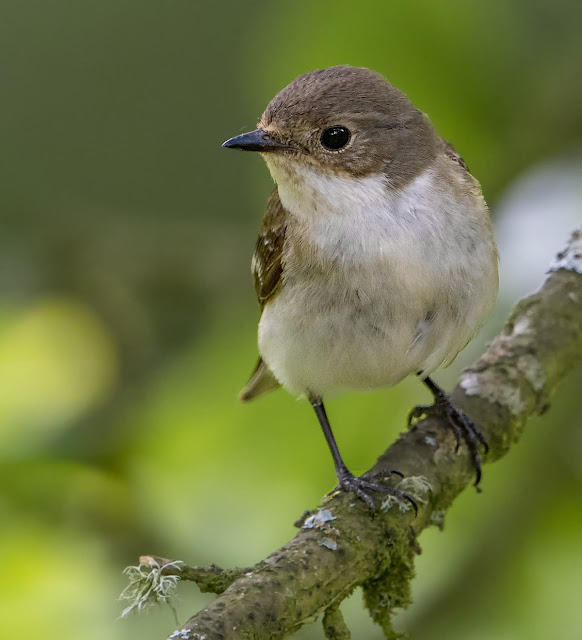
My next target was to go into Strid Wood proper and look for Flycatchers - after chatting to the two other guys it seemed that the prospect of seeing Spotted Flycatchers was going to be very low, but the Pied Flycatchers were guaranteed as they were using the nest boxes provided for them in the woods. And indeed this is what happened.
It was very dark and shady in the woods and so it was hard to get a clear shot of these small birds in good light, especially as the light was ever-changing. I got one good chance at a female bird but my best shot of the male was at the nest box as it brought food back to the young.
I need to state clearly here that all these photographs were taken from the path with a long lens, teleconverters and a crop sensor camera, as there have been a lot of complaints in one particular Facebook group about someone who sat leaning against a wall under a nest box whilst the birds were alarming around him for being too close. All I can say about that matter was that it wasn't me.
After an hour or so in the woods I decided I wasn't going to do any better today and returned to the bridge area where I was very surprised to see that Martin and Tony were still there photographing the Redstarts. Sarah had returned to the car for our sandwiches and had been kind enough to also bring my tripod, which I had decided against earlier. So after our lunch, I stayed for another hour or so to get some more stable Redstart shots and Sarah went to read her book in some very picturesque surroundings.
Sarah and I had intended to go on to Malham Cove for another attempt at some Peregrine flight shots and so I left Martin with the Redstarts and headed back to the car. I did want a quick look at an accessible
Sand Martin colony he had told me about upstream from the Barden Bridge car park, but when I got there the birds had all fledged and all I managed was this shot of a
Common Buzzard. Ah well, I'll have to come back earlier next year.
I returned to Sarah in the car and put Malham into the Landrover SatNav expecting a 45 minute journey as had been shown on Google Maps when I looked on my phone earlier in the day. I had a rough idea of the route and so when the SatNav took me in the opposite direction to what I was expecting, I started having doubts about where it was taking us.
For a while I just thought that the SatNav knew a different route to the one chosen by Google, but after half an hour of going in what I thought was the wrong direction, my concerns were proved to be correct. Eventually we ended up in a location that we could have got to in 15 minutes if we'd just gone back the way we came - and not only that, the rush hour traffic was building up too. So when the planned 45 minutes was up and we were still a long way from Malham, we decided to call it quits and come home. I'll never trust that Landrover SatNav again!