Wednesday, 7 March 2018

How Can Such Little Birds Be So Frustrating?


I spent a very frustrating afternoon at Wombwell Ings in the Dearne Valley, Yorkshire trying to photograph a Yellow-browed Warbler and a Firecrest this afternoon. The Firecrest was present but I didn't see it at all (well maybe a fleeting glimpse) and the Yellow-browed Warbler was very mobile, secretive in the shade and nearly always covered in twigs.


If it wasn't for the excellent company of Paul Coombes, Paula Sykes and Graeham Mounteney I'd have left quite disappointed, but the banter made up for the frustration, and a lifer is a lifer after all.


Above are a few record shots, best viewed small.

Monday, 5 March 2018

Well, at least it hadn't Scaupered!

For a quick trip out this afternoon, I decided to finally pay a quick visit to the long-staying female Scaup at Elton Reservoir in Bury.  All the time I was driving, I was just hoping that I'd see it and that it hadn't scarpered!


The last time I was here was when I saw the Common or Mealy Redpoll back in January, a bird which has only recently been accepted by the Greater Manchester Rarities Committee.  I had intended to pop in here on my way back from visiting the Glaucous Gull at Hollingworth Lake last month, but the weather conditions were so bad that I called it off.


Today the weather was sunny when I set off, but it became more and more cloudy as I approached the reservoir.  On arrival I met Steven Higginbottom, co-finder of the Mealy Redpoll, and I quickly asked if he had seen the Scaup - he hadn't, but he'd only had a quick look from the Creek area.  However, I marvelled at the fact that he told me he could make out some waders, probably Dunlin, on the small beach across the water at Wader Point though.


I asked him which would be the quickest way of getting down there, as at least I could get some wader shots if I couldn't find the Scaup. He suggested walking around on the path on the pump house side of the reservoir, as the one on the Creek side was very muddy, and so that's what I did.


Fortunately, when I arrived at the bay in the south-west corner of the reservoir, I spotted the Scaup which was loosely associating with a small flock of Tufted Ducks. It was quite unmistakable from the female Tufted Ducks, being slightly larger, with a large white patch at the base of its beak and a grey/brown back and sides. However, as soon as I approached the birds they spotted me too, and started moving towards the centre of the bay.


The light was all wrong on this side, so I walked round the other side of the bay only for the flock to move away again.  I spent the next two hours or so trying to get closer by walking to and fro trying to get ahead of them as well as a little closer with the light behind me.  The Scaup was always on the periphery of the group, and usually the furthest away, often preening and resting whilst always seeming to keep one eye on me.


So, due to the poor light and distance, all these shots are only really record shots, but the bird has taken my year 2018 Year List up to 124.  There were also Great Crested Grebe on the water and three Goosanders dropped in as I was leaving - I never did see any waders today though.

Friday, 2 March 2018

Bramblings And Other Ramblings

Today I finally paid a visit to Newchurch Common in Cheshire where I met up with Paul 'Doc' Brewster who had kindly agreed to show me around his local patch. We had arranged to do this many weeks ago, but bad weather on the day forced us to call it off.  So with a window of opportunity presenting itself, I grabbed it.


Paul is a very well-respected local birder who helps run the well-known FocalPoint Optics shop in Cheshire. I have met him on several occasions previously, with our first encounter being at a summer fayre event at Pennington Flash where FocalPoint had a stall.  Following this event the L.O.S. Young Birders' Club eventually bought six pairs of binoculars from FocalPoint and we have been in contact ever since.  The first time I met him out in the field was at Binn Green near Dovestones, when we were searching for a Two-barred Crossbill.

Smew Photo to go here ....

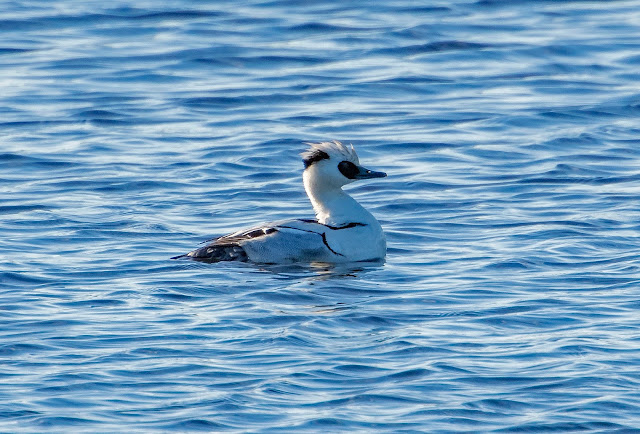
My two main target species for today were the resident female Smew and the huge flocks of Bramblings that have been reported here since before Christmas.  We started at Beach Peg where the day got off to a big surprise, much to Paul's delight when we came across a herd of 37 Whooper Swans which had landed on the Big Pool.  They had probably been grounded by the very cold weather and might even have been starting to make their way back north. The Whoopers were a 'patch life tick' for Paul and he quickly hurried back to get his camera and scope to get some shots.  I stayed put and took some shots for him, just in case the birds decided to fly before he got back.


It took a while for this excitement to die down, but shortly after we were looking for the resident female Smew.  A recent sighting of a female Smew not too far from here at Astbury Mere had raised the question of whether it was the same bird as the one at Newchurch.  We looked around but couldn't see her here, so it was still  a possibility.  There were however, at least nine Shoveler feeding in their characteristic circular motion on the far side of the pool, and quite a few Great Crested Grebes.


Soon we were off on a clockwise walk around the lake, with Paul pointing out all the watchpoints, which tended to be named after the fishing pegs.  After a short walk through a wooded area, we came across the Smew making its way in to Willow Arm Bay, and after that we wouldn't see it again today.  And  later in the day, a report of the same same time period from Astbury proved that there are in fact two Smews in Cheshire at the moment.  We also caught sight of a Redhead Goosander flying low over the lake.


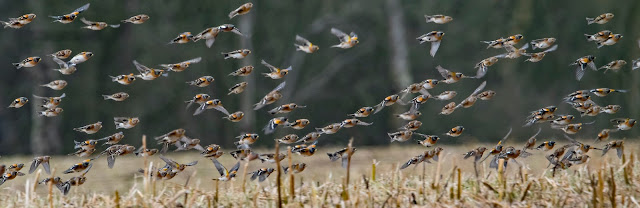
From here we walked to what was actually the highlight of the day for me - at least 300 Bramblings feeding in a newly-cut set-aside field, with almost as many Chaffinches.  I had never seen so many of this stunning little bird, with 30-40 birds at Woolston Eyes being my biggest previous count.  It was an awesome spectacle and very difficult to capture in a photograph.


To finish off we retraced our steps back around Big Pool to try to get a better view of the Whoopers.  Paul pointed out Finch Hedge and good spots for Green Woodpeckers which breed here in the spring and summer.  We ended up at another fishing peg where the Whoopers seemed to drift towards us instead of moving away, as if they were expecting to be fed. I suggested that they seemed a little tame and that it raised the question of whether they were from somewhere that feeds them such as Martin Mere WWT.


I thanked Paul for a great tour of his patch and told him I'd definitely be back and possibly quite soon to try and get some better shots of the Brambling.


On my way home I called in at Marbury Country Park to have a look for the Bitterns and Hawfinches that had been seen quite a few times recently.  I had no luck with either of these but I did have eight Bullfinches feeding on buds in the trees around the car park, as well a few close up shots of common birds on a feeding table.  It was too cold to stay long but I had a pretty good day on the whole.


Tuesday, 27 February 2018

Smew, Smew, Goldeneye too ...

We've had a long-staying drake Smew on the Wigan Flashes for a while now, but unfortunately I decided to go to see my son Robert in Kent whilst it was here.  So you can imagine my desire to see it if was still present when I returned.


I asked if it was still present on our North West Birding WhatsApp group and after a phone call from fellow L.O.S. member George Pike telling me the bird it was, I decided to brave the minor blizzard in Tyldesley and hotfoot it to the Wigan Flashes.  The weather here was totally different, with bright sunshine when I arrived. 


I met George outside one of the entrances to the Flashes just as he was about to leave.  He told me that he'd had good views but the bird has flown out of view behind the small island of trees on Scotman's Flash.  It didn't show again for around two hours and the light slowly deteriorated whilst I waited for it to reappear.

Whilst I was deciding what to do do next, I met up with Wigan Flashes stalwarts David Bretherton and Warren Topping and they convinced me to walk back along the canal with them and have another look.  David left Warren and me to carry on looking and I eventually spotted the bird flying and then landing in the middle of Scotman's Flash.


Although it did slowly make its way to the eastern bank of Scotman's Flash, it never really came that close. Warren and I tried to approach it several times using the few trees and bushes along the bank for cover, but it seemed very sensitive to our movements even from a long way off. So I had to be happy with these distant shots.


Whilst waiting for the Smew to appear I took some video of two mating Goldeneyes.


Monday, 26 February 2018

Kent - Garden of England - Day 3

Yesterday I had a day off birding and so I was keen to get out today.  I decided to go to the Oare Marshes on the North Kent coast, not far from where I was on Saturday at Conyer. The target species were Water Pipit and Long-billed Dowitcher.


This was the closest I got to seeing the elusive Long-billed Dowitcher!

And then is was back to Elmley to try agin for some decent Marsh Harrier shots.


Saturday, 24 February 2018

Kent - Garden of England - Day 2

Today I went out on my own starting with a visit to Elmley Nature Reserve on Sheppey in the morning followed by a trip to Conyer on the North Kent coast to see the ten Shorelarks being reported there in the afternoon.  As with many trips, things didn't go exactly as planned.

Elmley Nature Reserve is divided into two parts, a two mile long winding track where you are not allowed to get out of your car, but can pull over and stop almost anywhere to view the birds and the former RSPB nature reserve where you can only walk to the hides surrounding a couple of lakes and overlooking the sea wall which borders the Swale.  The track is free to use, but it's expected that you'll donate £5 in an honesty box (which I duly did) as a contribution to the upkeep of the reserve with the hides.

I was very keen to visit Elmley as it is the place from where all the great photographs of Marsh Harriers were being posted on Facebook, but I only had a few distant views of them today.  There were plenty of Lapwing and Coot along the winding track which ends at a farmhouse and a few other buildings, but very little else.  After chatting to a very helpful local worker on the reserve, I was told that as there was no-one about today I could actually drive to old RSPB hides and save myself a 40 minute walk carrying my camera gear.  I was so glad I did this as when I got to the hides there was nothing much to see.

After a slow drive back along the track with only a couple of glimpses of Marsh Harriers, I decided to cut my losses and head for Conyer.  This meant driving back over the Swale and onto the mainland, but this time I used old lifting bridge rather than the new fixed bridge.

On arriving at Conyer I talked to a couple of people about where the Shorelarks had been seen and found out that they were quite a long walk around the other side of the marina and creek, with no short way of getting there.  Foolishly, I decided to have a look at the Swale shore from this side first and ended walking quite a long way for very little reward and still having the prospect of a long walk around the creek.

Uncertain about exactly where I was going, I got talking to  lady dog walker who guided me round the sailing club and creek an put me on the right track to the fields where she seen lots of birdwatchers in the previous week. It took quite a while to find the Shorelarks, but I eventually did with the help of three lads who knew where they'd been seen, but who had not actually found the birds themselves.  It was very cold with a biting wind and they'd eventually decided to call it a day - I however, was determined not to draw a blank.

Snow Bunting
It was actually the number of birds that got me on to them, with ten little brown jobs flitting around in a field.  They were quite mobile as they fed and soon moved on before eventually coming up to the sea wall.  None of my photographs are any good, but I did manage to capture a single Snow Bunting whilst attempting to shoot the Shorelarks.

Redshank calling in flight
These birds were to give me the runaround for three hours or more whilst I tried to get close enough for a decent photograph.  During this time the tide was coming in along the Swale and soon there were movements of birds which were being displaced by the incoming water.  My high position on the seawall overlooking the Swale gave me a good vantage point for some flight shots as the birds flew upstream, especially with having the sun on my back.

Dunlin
Curlew


Turnstone


Avocet


A Flock of