Friday, 16 February 2018

Only My Second Ever Visit to Crosby Marina

There has been a solitary male Snow Bunting in the dunes with the Skylarks at Crosby Marina near Liverpool since before Christmas, and today was the day to add it to my 2018 year tick list. The first time I came here was in 2015 when a long-staying female Long-tailed Duck was giving close views on the small boating lake.

I found the bird chasing a Skylark around the grassy rucks as soon as I arrived - the wing pattern and colours were unmistakable.  It landed briefly in a bush and then on a fence on the far side of the rucks, but then took off towards the dunes and despite several circuits of the grassy areas and the dunes, I couldn't relocate it for over an hour.

But then, just as I was completing my third circuit, I found it feeding alone on the thin sandy path at the base of the dunes.  I managed to get quite close, and then it flew towards the wire fence before landing in some vegetation.


This seemed to be its 'patch' and indeed, it's the place where it's been most often seen here.  Whilst on the fence it was always on the look out for Skylarks and eventually it took off chasing one of them and I didn't see it again.  Fortunately I had got some shots in the bag by then.


This Cormorant went over shortly after the Snow Bunting had flown off.

And I took this Common Gull on a post shot on one of my circuits of the grassy ruck areas.


As soon as I had grabbed a few shots of the Snow Bunting I put it out on the new North West Birding WhatsApp group I recently created and Paul Bennett, who I had recently met at the 'Poynton Waxwing', was just arriving at Lunt Meadows 15 minutes down the road from Crosby, and so he diverted and came here instead.  We had a chat and I explained when and where I had seen the bird and I left him hunting it down as I was heading for Lunt Meadows myself.

Paul Bennett - 'Man On A Mission'

I believe he did eventually see it, but only from a distance, so I'm sure he'll be back.  But just before I left I got some nice shots of this Black-tailed Godwit on the grassy area to the right of the lakes.


I finished off here with this shot of two Carrion Crows enjoying a quick smoke on the chimneys of one of the big posh Victorian seaward-facing houses on the seafront.  Oh, what decadence those must have seen in years gone by!


UPDATE:

My Snow Bunting shot featured above was awarded 'Photo of the Week' on BirdGuides today:


Here's what Steve Young had to say this time:
Wintering Snow Buntings are always a popular subject among birders and photographers alike, and this season has been no exception with large numbers of images uploaded to our galleries. The lone male individual at Crosby, Lancashire, has been particularly photogenic and Martyn Jones has captured a wonderful shot as it lands on a dead stalk.

Crisp, winter light has brought out all the feather detail and allowed a fast enough shutter speed to freeze the action. This would have all been over in a second, so the photographer has done well to be ready, focused and then fire off a couple of shots.

Congratulations to Martin on his winning image. It was taken with a 500-mm lens, 1.4x converter and shot at 1/5000th sec, f6.3 and ISO 800.
I think I'll forgive him spelling my name incorrectly in the last paragraph. That's two POTW's I've had in the first two months of this year - not sure I can keep that up!

Thursday, 15 February 2018

What's This Common Scoter Doing Here?

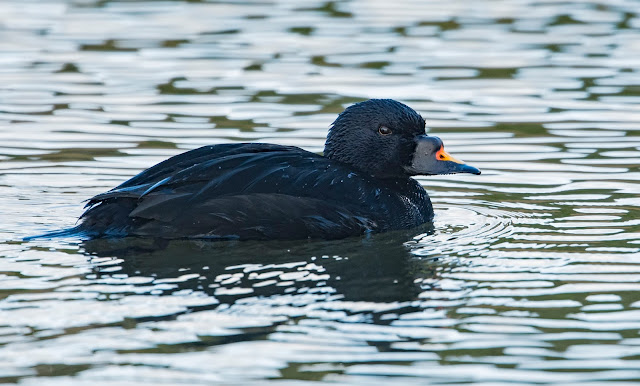
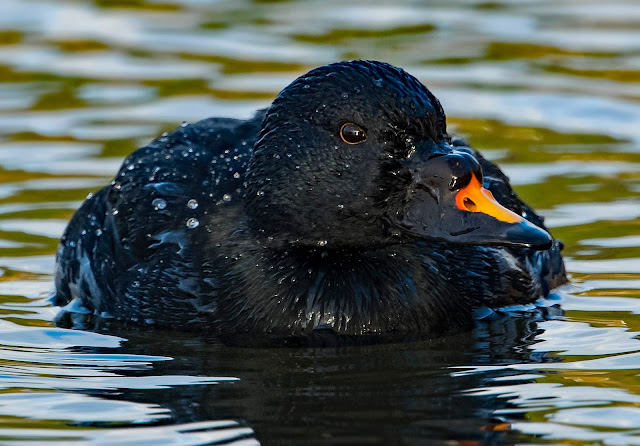
A Common Scoter has been giving very close views on Barrow Lodge near Clitheroe for over a week now., Because this is a sea duck which normally feeds and roosts in huge rafts of similar birds way out to sea it's rare to get close to them and so this one was a must to photograph.


Wednesday, 14 February 2018

The Solitary 'Poynton Waxwing'

Some winters are great for Waxwings whereas others aren't. Large influxes of birds like Waxwings, Bramblings and Hawfinches depend on the weather and food supply in the countries from where they originate - if the weather and food supply is good, they don't need to migrate so far for the winter.


This year has been great for Hawfinches, not bad for Brambling but mediocre for Waxwings. So when birds do appear, even just one, there is a lot of interest from the birding community as the news gets round.

I tried for a single bird in Sprotborough near Rotherham recently, because it was regularly visiting a street with plenty of cotoneaster berries.  I sat for an hour and half in the road facing someone's house waiting for this bird to arrive, and it didn't.  All I had was a solitary Blackbird where the Waxwing should have been.  I viewed never to travel more than a few miles for just a single bird ever again.


But this solitary bird was and, as I write, is still being seen regularly in a suburban street in Poynton, Cheshire, so the prospects of seeing it were good and I decided to go.  When I arrived there were three other birders present, so I just looked up and there was the Waxwing.


The birders were locals Phil Oddy, who had kept us updated on Facebook and WhatsApp almost every day since it was first spotted, photographer Paul Bennett and professional wildlife photographer and guide Ben Hall who happened to live in this very street.


We had plenty of time to chat about life, the universe and everything because the bird spent most of its time up in a bare tree and only came down very briefly for a few seconds to feed on two small Rowan tree with yellow berries.


As you can see from the photographs, the weather wasn't great and the light was very poor, but I wasn't too upset about this as I've got good Waxwing shots from previous years.  I only really came because I probably won't get chance to see another one this winter.


Monday, 12 February 2018

Looking For More Year Ticks

For the first time since I started serious birding in 2009 I have decided to keep a '2018 Year List' this year. This has been spurred on by the fact that I've started using Bubo.org to maintain my lists, which was first recommended to me by Gareth Hughes a couple of years I go.  I had a quick look at it then but didn't persevere.  Now I think it's the best thing since sliced bread for keeping bird lists and indeed, I've also added my 'UK Life List' and 'Greater Manchester Life List' to Bubo.  Here's where I currently stand:


So today I was off in search of more '2018 year ticks' mainly in the form of a Kingfisher at the Wigan Flashes.  I also was hoping to get some close photos of a drake Goldeneye which has been giving very good views on the canal recently.


I started off at the Hawkley Hall Feeding Station which was only a short distance from where I parked my car.  Here I was expecting to see Willow Tits, Reed Buntings, Chaffinches, Long-tailed Tits, Blue Tits, Coal Tits, Great Tits and Robins, none of which disappointed.  What I wasn't expecting to see were male and female Bullfinches and even less so the normally very shy and elusive Water Rail, so that was a real bonus.


Friday, 9 February 2018

A Day in Holme Pierrepont, Nottinghamshire - Part 2

So with one new year tick and a lifer to boot under my belt, I then set off for the bonus bird.  A 1st-winter male Long-tailed Duck had been reported on the main rowing course in front of the Watersports Centre.


On the way round from the white-water slalom course I stopped briefly to chat with a birder with a scope, asking him if he'd seen the duck.  He had but form the other side of the water, but couldn't relocate it now with his scope.  However, he informed me that it was diving repeatedly and was very close to the jetty.


I drove round, parked up and then made my way to the jetty in front of the Watersports Centre.  From a distance I could see that the person who had been photographing the Spotted Sandpiper with me on the white-water slalom course was already on the edge of the water with his camera.

The Long-tailed Duck was bobbing around just a few metres in front of him giving excellent views.  I soon joined him and was firing shots away.  The bird would repeatedly dive for about 30 seconds and then resurface, look around for a bit and dive again.  On average I had about 20 seconds or so to get a shot. The sun quite low and harsh by now, so I underexposed all my shots in the hope of not blowing the whites in the birds plumage and so losing detail.  This has saturated the colours somewhat, but given nice detail.


After fifteen minutes or so the other chap left but I decided to hang around for a while longer.  Just before I was going to leave the duck dived down and caught something - I couldn't tell what it was at first, but from the photographs (and after much discussion on Facebook) I have now been reliably informed that this is a Bullhead fish. Needless to say, I'm very pleased with this image.

A Day in Holme Pierrepont, Nottinghamshire - Part 1

I'm not really sure how the area known as Holme Pierrepont got its rather exotic name but it's home to the National Watersports Centre where many of our elite rowers, canoeists and kayakers train for sporting events on the water.  Funnily enough, Olympic silver medalist Paul Radcliffe, the current Director of the Centre is from Tyldesley where I live and went to our local high school where my wife Sarah briefly worked with his mum in the Science department.  Small world eh?


But it wasn't watersports that brought me two and half hours down the motorway here away from Tyldesley, it was a little bird and in fact another lifer - a Spotted Sandpiper.  The Spotted Sandpiper is a winter vagrant to the UK which breeds in North America and which gets its name from its spotted breeding plumage.  Apparently there has been one breeding attempt recorded in Scotland where three eggs were laid but didn't hatch.

Armed with some excellent instructions from Paul Coombes, a Facebook buddy of mine and one who I actually met when he took me to see the Nightjars near Budby in Sherwood Forest, I arrived at the white-water canoe slalom course without any difficulty. Finding the bird however, was a little harder.

It had been most often seen between two of the bridges over the slalom course and on reaching the first bridge I met a nice young couple who had been looking for it without success. We decided to walk down to the second bridge on opposite sides of the narrow water channel looking on the grassy banks bordering the water, with the promise of waving to each other if any of us saw it.


At the second bridge I met up with three more birders, none of whom had seen it today. So we went off in different directions to scan the area.  Having had no luck myself, I decided to return to the second bridge and, as soon as I arrived, one of the young birders came running to me to tell me it had been found upstream. Great stuff,  much appreciated! It's always good to have a few pairs of eyes.


The bird was on the concrete edge of the slalom course looking for food. We viewed it from the bridge for a while, but as it didn't seem unduly bothered by a dog-walker and some other passers-by, we decided we could get closer.  Walking a long circle away from and around the bird, I joined up with a second photographer who was on the edge of water course about twelve metres form the subject.


It was quite active and soon flew up onto the grassy bank for a short while, before crossing the water to the bank on the other side.  We decided to let it settle and viewed it from afar for 10 minutes or so, giving another pair of birders with a scope and binoculars time to have a good look at it.  When they left we decided to get a bit nearer - we stayed low on the edge of the water and got down to around about 20 metres away from the bird.  It wasn't at all bothered by us and was happily looking for food in the grass.


And then the best moment came, it caught a long worm.  After playing with it for a couple of minutes it took the worm down to the water and washed it, before eventually managing to swallow it.  After this it went up the grassy bank slope again and we left it in peace to digest its meal.


Common Sandpipers and a Spotted Sandpipers are very similar, especially in winter plumage. The main differences seen in my photos of the Spotted Sandpiper are the yellow leg colour and the shorter tail projection. This bird is obviously in its winter plumage, so perhaps not quite as attractive as when in its spotted breeding plumage but it was still a very nice looking bird.

Wednesday, 7 February 2018

Darley Dale in Derbyshire

Doesn't that title have a nice ring to it?  It's almost as nice as the journey through the rolling Derbyshire dales to get to this small village near Bakewell.  The last time I was anywhere near here was in December 2016 to see the Dusky Thrush at Beeley, and as I went off in search of Hawfinches today I remembered how much I enjoyed myself that day too.


I was quite amazed that my satnav was able to take me straight to St. Helen's Church where over twenty  Hawfinches have been seen regularly since late December.  With so many birds around it seemed an opportunity not to be missed, especially when I'd had such a bad experience at Broomhill Flash in the Dearne Valley (near Old Moor RSPB) and Worsbrough looking for far fewer birds.  I did see the regular female Hawfinch at Broomhill but only very briefly there was no chance of a photo.


So today the prospects were good, however it didn't quite turn out that way.  Yes, there were at least twelve birds about and some said they'd counted twenty-two.  But they were very mobile and mainly feeding in the shadows.  The birds would feed for a while and then disappear for a much longer while, returning just three times whilst I was there.


About twelve photographers were present during the day all trying to get some shots like me.  In general they were a very pleasant and well-behaved bunch and I enjoyed chatting with many of them during the long lulls in activity.  Many of them had been before and were just trying to get better shots of these very shy and elusive birds.  For a few, the Hawfinch was a lifer for them.


However one photographer really got on my nerves as he stomped about the church grounds and graves mumbling to himself or giving us all a running commentary abut what he was thinking and often shouting out loudly to someone else.  He didn't seem to have any respect for the other photographers who were all keeping quiet and none at all for the hallowed grounds of the church either.  I later found out that this guy is well-known, particularly around Derbyshire and is so thick-skinned there's no point in telling him about his behaviour, which for me was totally unacceptable and the kind of thing that give all photographers a bad name. Rant over.


So what can you do whilst you're waiting for the main event? Well take some photos of other birds of course.  It really was the 'Day of the Finches' here, with Greenfinches being the most numerous birds about and Hawfinches being a close second and a few Chaffinches. There were also lots of Goldcrests, Nuthatches and Robins in the church grounds as well as a single Song Thrush.  And all the time there was the constant racket of a rookery high up in some nearby trees, with lots of nest building activity beginning.


At the end of the day I had a nice long talk with freelance sports photographer Steve Bond (he also shoots wildlife, music and fashion) about photography and other stuff.  Steve had arrived quite late in the day as he just decided to pop in whilst en route to giving a talk to a photographic club in Chapel-en-le-Frith. He gave me some nice tips for photographing Bitterns at Minsmere which I aim to do later this year.

My last photograph of the day was of this Rook trying to be a living gargoyle. Well, there was nothing else to do as the Hawfinches never returned today whilst I was there.