Monday, 11 November 2019

Three Blokes in a Transit


The start of the 'Transit of Mercury' as seen from Ty Mawr Country Park, Rhuabon near Wrexham in North Wales on Monday 11 November 2019.

This story starts with a little fun astronomy group (Leigh Astro Society) that we set up back in October when three of us visited a dark sky location in the Forest of Bowland in search of Andromeda. The founding members of the L.A.S. were Paul Richardson, George Pike and myself.  Following this meeting I set up a Facebook group and the online membership has now grown to seventeen people, with around five people regularly posting photos or useful information for the group.

One of these posts concerned the approaching 'Transit of Mercury' which is a reasonably rare event and so some of us got interested in seeing and hopefully photographing it.

To do this we'd need solar filters for our 'scopes and camera lenses. Paul, who is the only true astronomer amongst us, had already made one previously for a telescope, which he then adapted to fit his camera.

I, on the other hand, am a compete novice to astrophotography and when I realised that Paul's filter wouldn't fit my camera so I couldn't borrow it, decided to make my own at the very last minute - two days before the transit in fact with one of those being a Sunday.

I'd left it too late for the required Baader AstroSolar Safety  Film to be delivered from an online source, and so after a frantic morning of phoning up every nearby camera and telescope shop without any luck, I decided I'd have to make the three-hour round trip to Rother Valley Optics near Sheffield to ensure that I got some in time.


Anyway, I did the trip, got the film and spent Sunday afternoon making two filters, one for my 500mm lens and the other for my 300mm lens just in case there were any issues.  I was reminded of the old Blue Peter programmes as I cut the required shapes out of card and then used double-sided tape and sticky-backed plastic to fix them together. It was tight making two filters out of a single piece of A4 film, but at nearly £20 a sheet I wasn't going to waste any of it!


Filters made, it was time to decide where we'd be going to get the best chance of seeing the sun.  The weather forecast wasn't good with a front bringing cloud and rain over the North West during the day.  Paul decided that North Wales would be the best place to try, with a couple of possible locations in mind, the first being Ty Mawr Country Park in Rhuabon near Wrexham. We turned up at George's house at 10am and by 10:15am we were on our way with George driving - well he had said he'd be willing to drive up to 50 miles to see the Transit and that was going to be more or less right.

One of the first photos I took of Mercury;


The small black speck on the left side of the sun isn't dust but the planet Mercury, which only passes in front of the sun every 15 years or so. Mercury is 57.91 million km away compared to the sun's 149.6 million km, so it's nearer to the Earth than the sun. It's also only 38% of the Earth's size.


It's so small that you'll need to view these fullscreen and it can't be seen with the naked eye. You must never look at the sun through bins or scopes unless you have a special solar filter which cuts out 99.99% of the light and radiation.


The actual colour of the sun is white but I increased the white balance in the first shot to make it the more familiar orange colour we see, which is caused by our atmosphere scattering the light.
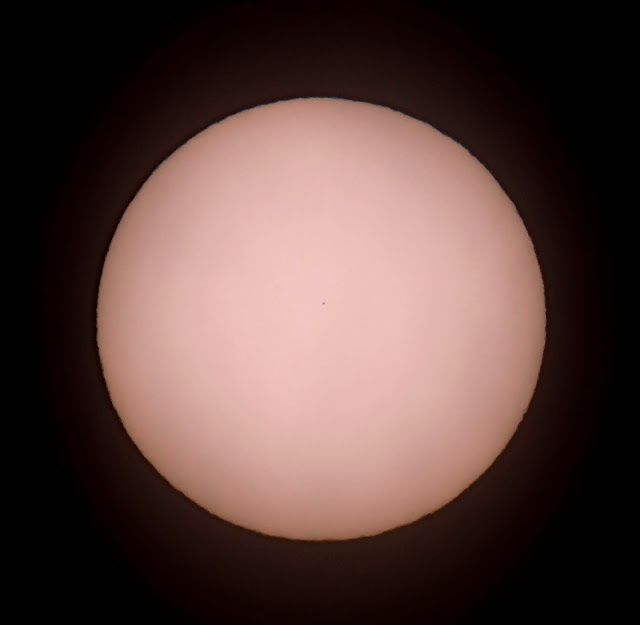
It definitely seemed to become more orange as it descended below the hills.

And so to bed ...


The founding members of the Leigh Astro Society.


Wednesday, 30 October 2019

Fame at last!

I've not posted for a while for various reasons but I had to say something about this photo of mine which was used on prime time BBC AutumnWatch tonight. This is the second time I've had a photo shown on the BBC's SpringWatch series and so I'm very slowly building up a portfolio!

I was sitting there watching AutumnWatch and thinking that this was a really good explanation of our current weather patterns in relation to the Jet Stream, when up popped this photo of mine! It was being used to show how the recent weather has brought rare American visitors to the UK.


Here's the three minute segment from BBC AutumnWatch which featured my Red-eyed Vireo photo. I thought that weatherman Nick Miller's explanation of how the current weather patterns being controlled by the Jet Stream are suppressing migrant birds from the east whist bringing vagrants from the west was very good.


Well, I didn't see that coming!

And here's my original photo:


Sunday, 27 October 2019

Day 7 - Saltholme RSPB


No sign of the American Golden Plover in amongst a few thousand Golden Plovers!


Wednesday, 9 October 2019

YATL

Here's my current YATL post - Yet Another To-do List!
  • Leigh Astro Society in the Forest of Bowland 1/10/19
  • Marshside RSPB 16/9/19
  • American Golden Plover - Lunt Meadows 16/9/19
  • Belmont and Rivington Stars - 13/9/19
  • Eastern Black-eared Wheatear - Fluke Hall, Pilling 10/9/19
  • Marshside RSPB 10/9/19
  • L.O.S. at Blacktoft Sands RSPB - 8/9/19
  • Tophill Low NR - 13/8/19 - still needs text
  • Lake District and Leighton Moss - 12/8/19 - still needs text
  • Little Bustard and Adel Dam 8/9/19 - partially done
  • Little Owls at Holcombe and Burrs CP 6/8/19 - still needs text
  • Blacktoft Sands RSPB 30/7/19
  • Dunham Park 29/7/19 - still needs text
  • Puffin Cruises Coquet Island Boat Trip - 19/7/19 - partially done
  • Billy Shiels Farne Islands Boat and Landing Trip 2019 - 18/7/19
  • Bempton Cliffs RSPB - 15/7/19 - partially done

Tuesday, 8 October 2019

Waxing Gibbous Moon - 7-8/10/19

The waxing gibbous moon as seen from my front garden in Tyldesley. Waxing means that it's getting bigger. Gibbous refers to the shape, which is less than the full circle of a full moon, but larger than the semicircle shape of the moon at third quarter.


Tuesday, 1 October 2019

Leigh Astro Society

On Tuesday 1st October 2019, three friends from the Leigh Ornithological Society (L.O.S.) went out into the depths of the Forest of Bowland in search of Dark Skies and Andromeda. It was on that memorable evening that Leigh Astro Society (L.A.S.) was born. A week later, the Society membership had doubled to six, with several notable experts in the field of astronomy, auroras and astrophotography. This is a record of that very first night.


I knew from the Manchester Birding Forum thread entitled 'Jupiter and its Moons' that Paul Richardson had an interest in astronomy and when George Pike told me that he had always wanted to see Andromeda I saw an opportunity for encouraging Paul to get his telescopes out of the back of the wardrobe and blow off the dust for a trip out with me tagging along as well.  After all, I had been developing my night sky photography skills recently too.

We discussed various locations but the Forest of Bowland always seemed to be the best chance of finding some Dark Skies within a reasonable driving distance.   For viewing of night sky objects,  clear skies and a moonless night, or as close as possible is needed. We had to wait for quite a while before the conditions were right.

Tuesday 1st October proved to be the night and we set off in the dark at 7:30pm with pretty cloudy skies, trusting that the Met Office app forecasting clear skies would prove to be correct. Fortunately, for once, it did. We headed up the M61 motorway and then across on the A59 to Clitheroe and up to Waddington where we parked in small lay-by along the B6478 Slaidburn Road. It was here that I took the 'Road to Waddington' photo (shown above and below) that we're currently using as a cover photo on out Leigh Astro Society Facebook group here:


I quite like this photo but I do hope to revisit the lay-by and take a better shot with the full arc of the road showing in it.  It was quite amazing how much traffic there was late at night on this B road.

Our first target was actually Saturn using Paul's big Celestron 8" reflector telescope. Unfortunately it was very low in the sky and in the same direction as the light pollution from Preston, but we could make out the tell-tale oval shape of the rings quite easily. No photographs though as it was too small and distant for my camera lenses.


Next was Andromeda and Paul used a smaller telescope to look at this distant galaxy as he was little unhappy with the performance of his large telescope, saying that it might need servicing. It was great to have my first ever view of our nearest galaxy, at only 2537 million light years away and which Paul said he could even see with his naked eye! Well, having spent a lifetime staring into cathode ray tubes and more recently LED flat screen monitors, I couldn't see it without using first binoculars and then Paul's telescope.  However, it was actually George's Swarovski bird spotting scope that gave us the best views on this particular occasion for some reason.  I managed to grab some poor but just about recognisable shots shown above and below.


After that we spent some time looking at the Pleiades and Hyades star clusters with Aldebaran at their feet as well as a few other constellations such as the easily recognisable Ursa Major (the Big Dipper or Plough), the 'W' shape of Cassiopeia and the square shape which forms the main part Pegasus. Oh, and the Northern Cross too.


Thanks must go to Paul for his knowledge of astronomy and the night sky without whom George and I would never have known where to look for and see Andromeda, Saturn and many other features. In fact we would have been almost totally in the dark (hehe!).


Son this evening Paul was duly elected Chairman of the newly formed Leigh Astrophenomical Society, which was later renamed to Astronomolgical and finally just Astro - being from the Leigh Ornithological Society we all know how important it is to keep your Society's name short and sweet!

We finished off this excellent evening with some arty-farty light painting by George ....


.... whilst Paul did his best 'Beast of Bowland' impression - you wouldn't want to meet him on a dark night!