Wednesday, 8 March 2017

A Trip to Wykeham and Scarborough

Ever since our trip to Spurn last month, George Pike and I had been talking about going to the Wykeham Raptor Viewpoint near Scarborough to look for Goshawks, so today we decided to do it, taking in the Pine Bunting at Dunnington on the way and Scarborough Harbour at the end.  Well, it was so close to our road it would have been rude not to.


With the Pine Bunting under our belt from Dunnington (details re in my previous posting) we were soon on our way to Wykeham Forest to look for the Gossies.  This was the first time either of us had been and so it was great that a couple of people who'd seen them that morning were already there with scopes.  It wasn't long before a distant Goshawk appeared and I could put it down as another lifer found.
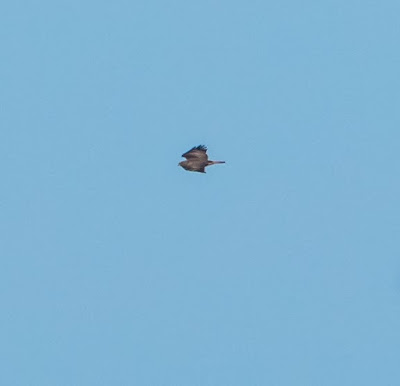

However, it must be said that I didn't have really good views and, if someone else hadn't seen them, I wouldn't have been sure that I had, especially as Goshawks bear more than a passing resemblance to large Sparrowhawks.  In fact, the only photos I got proved to be Buzzards in the end, and so I was quite disappointed by that.


Other birds we saw there included this Crossbill high up in a tree and a Redpoll of which I didn't get a photograph, but not really much else.


But then we moved on to Marine Drive at Scarborough and boy was that different.  Here the coastal road runs around the foot of a cliff face and we'd been told to look out for Peregrines nesting near lampost 55, so we parked the car there. The first birds that I noticed were several pairs of Fulmars nesting in the cliff and later flying in front of it.


As I was photographing the Fulmars, a passerby asked me if I could see the Peregrine and I said "No". She kindly pointed out where one was perched on a ledge and I had a chat with her and her partner about it whilst taking photographs.

But then a second Peregrine flew by, and the two birds chased across the cliff face before they both landed on separate ledges.

There a few further fly-bys by one bird whilst the other stayed perched on its ledge watching.

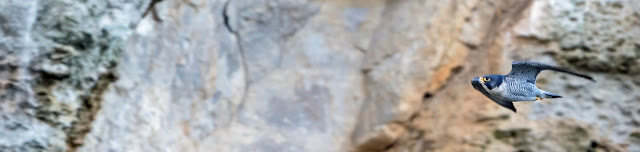
This is a great place to photograph Peregrines in flight as the cliffs making a stunning backdrop - much more natural than a chimney or building in a city centre and more interesting that a plain blue sky.

I think I'll be coming back one morning when the sun is in a better place for photographs.

Whilst I had been photographing the Peregrines, George had been sea watching and had come up with a couple of harbour porpoises, some Guillemots and a Gannet. He managed to put me on to one of the porpoises for a record photograph.

From here we went along the promenade to the harbour looking for a fish and chip shop for tea, followed by an ice cream - of course this was all due to George as he loves his fish and chips and he has such a sweet tooth.

There were three target birds for us to find that had been recently reported in the harbour: a Great Northern Diver, a Black-necked Grebe and a mysterious so-called 'funny duck'. It was the 'funny duck that I saw first and although George and I had some discussion about it, my initial ID was correct - it was a Guillemot coming into breeding plumage.

After we had eaten, we chased it around for a bit because it kept diving in and around the boats and coming up somewhere a long way off, but finally I managed a couple of half decent shots. We later saw it (or another bird) out on the sea.

We also had a small group of very tame Turnstones feeding on the harbour wall around the lobster pots. I've always felt that the Turnstones on the east coast are a lot more confiding than those which I usually see on the west coast, ever since I first saw them being fed crisps outside a harbour pub at Whitby.

Later we were put onto the Great Northern Diver by a couple who had just seen it at the end of the harbour wall and so we hurried on down there before it decided to leave the harbour for the open sea. 

We had really good views of it catching a crab and eating it and it came pretty close in at times.
We crossed over a bridge over the harbour at the sea ward end and walked along the harbour wall doing a bit of sea-watching. 

We saw another Guillemot and a couple of Red-throated Divers out to sea, but there was no sign of the Black-necked Grebe.

So George and I had a grand day out and saw a good range of species - so much so that we're thinking of suggesting Scarborough for an L.O.S. Sunday birding fieldtrip.

Another Mega Rarity in Yorkshire

A mega rare Pine Bunting in a hedgerow in Dunnington near York today. This was just a quick stop on a day out hoping to see Goshawks at Wykeham Raptor Viewpoint near Scarborough. In the end this proved to be one of the day's best sightings and we dropped in on it very quickly after arriving.


The bird was associating with a mixed flock of Tree Sparrows, Yellowhanners and Chaffinches which were all dropping down to feed on the ground in front of a hedgerow.  There were also s few male and female Brambling present making a really good mixture of species.


Friday, 3 March 2017

Boom! - Bittern at Mere Sands Wood

Remember that you saw them here first!

Text will follow shortly ...


The photo below got a 'notable' on BirdGuides.


Wednesday, 1 March 2017

Mere Sands Wood LWTT

After seeing reports of a Bittern which was showing well at Mere Sands Wood LWT, I set off today with high hopes of seeing it and perhaps even getting some photos.  I decided not to do the full walk round that I usually do, but to go straight to the Rufford Hide from where the Bittern has been seen.


I expected the hide to be full when I got there, but surprisingly it wasn't.  I managed to get a good seat overlooking the main spot where the bird had been regularly sighted and then sat for three or four hours either watching nothing or a vague shape rustling through the reedbed.


Fortunately there were  other birds on hand to relieve the boredom including a Kingfisher and female Goosander which gave excellent views.


It was also nice to meet up with Brian Rafferty, a chap with whom I have chatted over the internet with a couple of times and whose blog I follow form time to time. Indeed it actually was Brian who recognised me from my name and blog title.

Here's the Kingfisher fishing from a perch in front of the seedbed.


This female Goosander was patrolling the water in front of the hide.


And this Little Grebe was bobbing around in front of the hide too.


So after three or four hours sitting in the hide this was the best shot of the Bittern that I managed to get today, Anyone good a removing reeds in Photoshop?


Wednesday, 22 February 2017

Bluethroat at Willow Tree Fen in Lincolnshire


My visit to Willow Tree Fen in Lincolnshire was actually part of the journey down to 'Norfolk and Environs' where I was taking part in the Leigh Ornithological Society's 2017 Annual Winter Trip. However, this adult 1st winter male Bluethroat was such as special bird that it just had to have a post all to itself!


I'd first got wind of the bird a weeks or so ago and, after investigating its location, I decided I could try to see it on my way down to RSPB Frampton Marshes, the first stopping point for our L.O.S. trip.  I didn't know if anyone else in the party would want to see it, but as soon as I mentioned it there was a lot of interest.


Armed with a map and an excellent location description kindly supplied to me by Craig Storton who I contacted through Facebook, we found the location with little difficulty and, as we parked on the road near the bridge leading to Willow Tree Fen, we could see a group of people staring into the reeds along the path up from the bridge, just as Craig had said. After a wait of barely ten minutes or so, out popped the Bluethroat to feed on some mealworms which someone had previously put down for him and we had cracking views for around three to four minutes.


The bird is about the same size as a Robin, with longer legs and a slightly more upright posture. Indeed, like the Robin, it used to be classified as a Thrush, but now is thought to be more akin to the Old World Flycatchers or Chats. Like many birds they are insectivorous, but eat berries in the winter.


This is possibly one of the 'white-spotted' race rather than the commoner 'red-spotted' race although there is still some debate. Bluethroats are usually found on the east coast on passage in spring and autumn. However, there have apparently been records of them at Martin Mere WWT and Marshside RSPB in the past.

The Bluethroat normally winters in North Africa or the Indian subcontinent, but this one has presumably overwintered here in the UK as it's rather early to be seeing one here.


To finish off here's a very short video of the Bluethroat's behaviour on the path where it was it feeding. The crowd were ecstatic as it flew back into the reeds - listen to what I say at the very end of the video :)


The End