Tuesday, 16 October 2012

Leighton Moss RSPB

Mark Cain and I had been threatening to go out on a birding trip for a couple of months now, but for one reason and another it had always fallen through - however today we actually managed it and Leighton Moss RSPB was the chosen destination.

The main reason for this was because the Bearded Tits have started to be reported regularly on the grit trays once again, probably because their diet is changing from the insects they eat over the summer months back to seed and grain, for which they need to eat grit to help their digestive processes.  Another target bird was the Water Rail which is seen fairly often here and, if we were really lucky, a Cetti's Warbler might be heard or even seen too.

We set off at 7:30am because most people report the Bearded Tits as being around mainly in the early morning before 10am (although I have also now been told that they can actually appear at any time throughout the day).  The motorway traffic was very slow times and the weather was getting increasingly worse on the journey there, despite the forecast suggesting it would be fine.

Marsh Harrier
First stop was the 'Causeway' at Leighton Moss so that we could head straight for the grit trays and the Bearded Tits - we parked in small lay-by and could soon see a small crowd of people gathered for the same purpose as ours.  On arriving at the trays, there were no birds to be seen for 15 minutes or so, and as the weather was dull and damp, Mark and I decided to head for the Public Hide - this turned out to be an excellent decision as will be seen later.

There was not much to see from the Public Hide: a Grey Heron, lots of Coots and Mallards, a Black-headed Gull as well as a few Gadwall and Teal. But unfortunately the Otters weren't around for us today.

However, there was a lone female Marsh Harrier with a creamy head sitting in a dead tree at the far edge of the water. We watched it for a while in the hope that it might take-off and give up a fly-past but the bad weather seemed to be keeping it down.

Whilst we were watching the Marsh Harrier, both Mark and I heard a distinctive bird call just outside the hide and so we both headed for the door with cameras in hand.  Although I didn't recognise the call, I knew it was something worth looking looking for.

Outside the hide, we had a glimpse of a small brownish bird which flew across the Causeway which we thought it might be a Dunnock - but then we heard it call again and it definitely wasn't. We also heard a slightly different call low down in the bushes which Mark thought could be a Bearded Tit, but not being that familiar with their call, I had to take his word for it.  After unsuccessfully trying to find the bird(s), we returned to the hide where I mentioned that a Cetti's Warbler was often reported down here. That seemed to click with Mark and he said he thought that the first bird was indeed a Cetti's.

We heard it again on the other side of the hide and so went off in search of it.  There was also a very nosey Robin and a noisy Wren in the bushes as we hunted for the Cetti's.  We could hear it moving around and now and then would get a brief glimpse of it.  I took out my phone and played a recording of it's call a few times to confirm that this was what we were hearing and this seemed to attract the bird and keep it fairly close.  We also got a couple of good brief views and both added a new 'lifer' to our lists.

After this bit of excitement, we decided not to go on to the Lower Hide as it was quite a long walk and there was nothing much on the water which it overlooks.  So we headed back to the grit trays for another go at viewing the Beardies.  Another group of people had gathered, but still with no success, so after a quick chat we decided to move on to the hides on the salt marshes.

At Allen Hide we saw Black-tailed Godwits, Redshank, two Little Egrets and a crowd of whistling Wigeon.  We spent a long time debating whether we could see a Spotted Redshank or not, and I told Mark that it definitely was one, only to be told by someone later that it definitely wasn't one!  There were also a couple of Curlew and a Snipe, possibly a Jack Snipe according to another birder.

Red-breasted Merganser (showing sawbill)

At Eric Morecambe Hide we saw three Red-breasted Mergansers, two Grey Herons, a Little Egret, some Shelduck, Lapwing, Mallards and Teal.  Another Marsh Harrier also gave us a long fly-past in the distance.

Both these salt marsh hides have been completely replaced and so they are brand spanking new and smell of fresh wood - lovely!

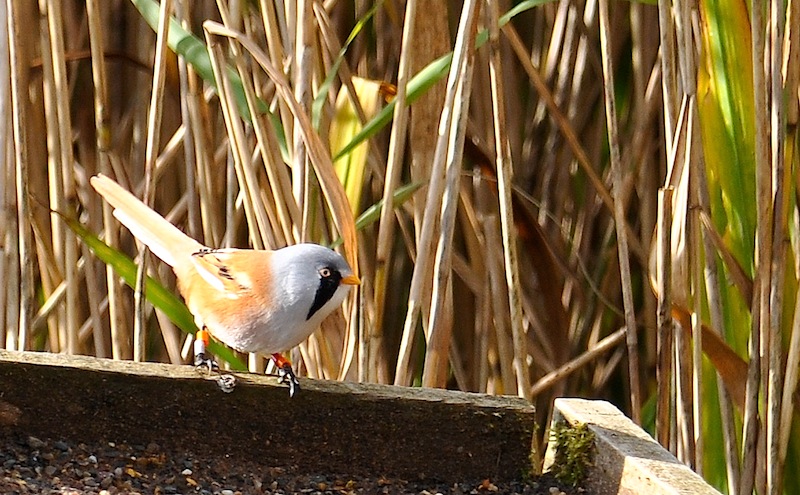
After this, we decided to go back to the grit trays for a quick look, before eating our sandwiches - what a good decision that was, as two Bearded Tits were now in sight.

Whenever the birds took up a decent pose the photographers fired off a volley of shots in the hope of getting just one decent photograph.  it didn't seem to worry the birds as they didn't fly off and must be quite used to the attention by now.
Female Bearded Tit on a grit tray
Male Bearded Tit in the reeds
First of all there was a single female Bearded Tit which doesn't have the black droopy 'moustache' and later came the very distinctive male.  Both were a beautiful creamy brown and white colour and they stayed on the trays for 15 minutes or so.

It was such a shame that each bird had three rings on it (two on one leg and one on the other) but they are being actively conserved here and we have to accept that ringing is part of the strategy for monitoring their progress.

Male Bearded Tit
Male Bearded Tit showing full 'moustache'

A Robin joining us for lunch
So after our second 'lifer', Mark and I headed back to the car for our sandwiches.  Here we were joined by one of the many tame Robins that are always present at Leighton Moss.

I know they're very common, but they're such a photogenic bird and they come so close that I can't resist taking just another photograph.


After lunch we headed for Lillian's Hide via the feeding station.

Chaffinch
The feeding station was quite dark today and full of Coal Tits - I've never seen so many in one place before.  There wasn't too much about, but the Chaffinches are always good for a photo.

There were two very well-concealed Common Snipe in the vegetation to the right of Lillian's Hide, some Pochards and Coots and not too much else on the water.  However the highlight was a very brief glimpse of a Water Rail which moved at lighting fast speed into the reeds to the right of the viewing area.

Can you tell what it is yet?
And finally we went down to  Griesdale Hide and Tim Jackson Hide at the southern end of the reserve. I don't often come down here as the sun is not usually well-placed for photographs but I did get a good shot of a female Teal at Griesdale Hide and we could make out a Red Deer stag and two fawns in the bushes to the right of Tim Jackson Hide.

Female Teal basking in the sunshine


So a total of 33 species which I think is quite a respectable total for the day.

A great day out in very pleasant company and I'm already looking forward to the next time I go out with Mark.

Sunday, 14 October 2012

BATH - Pennington Flash Fieldtrip

Today's 'Birds and their Habitats' (BATH) session was a fieldtrip to Pennington Flash in Leigh.  It was a pretty awful day for going out and about, but that didn't deter the intrepid birders from the Whitefield class.  Today we were joined by Barbara from the Ramsbottom class making a total of 12 birders plus Peter.

We got to Pennington Flash at 1:30pm and waited on the car park for everyone to arrive.  This area of the Flash is normally very popular with families who feed the ducks, swans and other birds here and this has caused them to amass in great numbers here.

Amongst the flocks there were Canada Geese, Mallard, Mute Swans, Black-headed Gulls and a large single resident Muscovy Duck (presumably a farmyard bird or escapee) which to me looks more like a goose than a duck.  There was also a small group of Moorhens on the grassy area to the left of the car park and many Coot in the water.

Willow Tit at Bunting Hide, Pennington Flash (Martyn Jones)
Peter decided to go to Bunting Hide first of all as it has been closing early on some days due to staffing problems and we didn't want to miss it.  Bunting Hide is a feeding station and therefore you are nearly always guaranteed a good number and variety of birds there.  One of the specialities here is the Willow Tit, a bird that we have recently been discussing in the class and some people come quite a long way to see them here.

Here's a photograph of a Willow Tit that I took here on a previous visit.

Other birds of note here are the very brightly coloured male Bullfinches, of which only one was seen today - but it did look very smart with it's newly developed plumage after the summer moult.  Sometimes there can 10 or 12 of these birds feeding here, along with the more subdued coloured females.

Chaffinch at Bunting Hide
There are always a variety of titmice at Bunting Hide and today we saw Coal Tits, Great Tits and Blue Tits.  There are also usually a few Long-tailed Tits here (although not strictly one of the titmice Paridae family) but none were seen today.  Male and female Chaffinches were also present as well as a huge party of Greenfinches feeding in one of the cages - there were at least 12 of them and I've never seen so many here at once before. Finally there was a Robin, Stock Dove and Moorhen bringing the species count to 10 - not bad for a start!

Greenfinch at Bunting Hide
From Bunting Hide we went on to Horrocks Hide, the largest and possibly best placed of all the other hides.  On the way there we had a brief stop to look over the Flash where we saw a Great Crested Grebe, Tutfted Ducks, four or five Pochard in the distance and some Gulls standing on the coloured buoys.  Peter pointed out that one of them was a Common Gull with yellowish-green legs and white 'mirrors' on it's wing tips but you really needed a spotting scope to see these features clearly. There were also both Great Black-backed and Lesser Black-backed Gulls on the other buoys.

Horrocks Hide overlooks a long thin strip of land known as 'The Spit', which is the remains of an old railway line that used to pass through this area.  In recent weeks the Spit has disappeared altogether under the volume of water caused by the very heavy and frequent rainstorms, but today a fair amount of it was viewable even though the water levels are generally still quite high.

A typical view of the end of 'The Spit' - Cormorants and Gulls


The Spit is often a great place to see waders, but today there were few if any about - even the normally present Lapwing were missing  The Cormorant numbers are increasing once again after their absence in the summer and there were at least two white-bellied juveniles at the end of the Spit.

There were also a lot of Canada Geese present.  In the pools there were Teal and Mallards, with a Great Crested Grebe in the distance.  Perhaps the best bird to be seen today were four Common Snipe which were distant and very well camouflaged as they sat low amongst the vegetation at the far end of the Spit, only occasionally wading in to the water.  To the right is a photograph I took of a Snipe here from earlier in the year:

Grey Heron at Edmonson's
From Horrocks Hide we went on to Tom Edmonson's Hide and the first bird we saw there was a juvenile Grey Heron.  The rain was starting to become very heavy by now so we were grateful for the shelter.

The shingle scrapes were all but under water and so there was little chance of any waders, but there were Gadwall, Teal and Mallard pairs feeding here as well as a single pair of the large-billed Shoveler.  The drake was just coming out of eclipse and starting to regain it's colour.  There was also a male Cuckoo! Wait ... did I say Cuckoo? Well it was actually Peter's excellent impression of a distant Cuckoo which he started up when I mentioned to Alan that I'd heard a Cuckoo here in the spring. I'm sure he's had many people fooled with that one before now!


Little Grebe at Ramsdale's Hide
After the rain had died down a little, we decided to move on. En route to Ramsdale's Hide a blackbird flew across the path and we could hear Long-tailed Tits in the bushes.  A member of the class was keen to see a Kingfisher here and it didn't disappoint, first by perching on a submerged post at the far end of the pool and then by flying fast and low across the water in a shimmering iridescent bue blur towards the left side of the hide.  Also of note here was a Little Grebe that put in a brief appearance amongst the usuals of Coots and Mallards and some Lapwing were seen briefly overhead. Outside in the trees, more Long-tailed Tits could be heard and Peter said he could also make out a tiny Goldcrest from its call.

Our final call for the day was at Teal Hide, which is a short walk through the trees towards the Golf Course.  On the way Peter stopped us to listen again for Long-tailed Tits and also Willow Tits, and there was also a Robin or two along the path. At Teal Hide the water level was very high and so there was little dry land for waders, as has been the case for most of this year.  There were however, several pairs of Shovelers, some Gadwall and Coots and a Moorhen here. And then it was time to go home.

So in summary, here's a list of all the birds seen today:

Great Crested Grebe
Great Black-backed Gull
Lesser Black-backed Gull
Black-headed Gull
Mallard
Moorhen
Common Gull
Canada Goose
Coot
Tufted Duck
Willow Tit
Coal Tit
Great Tit
Greenfinch
Blue Tit
Chaffinch
Stock Dove
Robin
Magpie
Blackbird
Grey Heron
Shoveler
Teal
Gadwall
Mute Swan
Snipe
Cormorant
Kingfisher
Goldcrest (heard)
Long-tailed Tit (heard)
Little Grebe
Pochard
Muscovy Duck (farmyard)
Nuthatch
Lapwing
Cuckoo (NOT!!)

Some 35 species - not bad for a dull and wet Thursday afternoon.

A great (if a little wet) afternoon out in very pleasant company - now I'm off for some soup and soldiers to warm up a bit - see you next week!

(Reposted with minor changes from an article on my other blog for the 'Birds and their Habitats' class.

Wednesday, 3 October 2012

Moses Gate Country Park

The sun came out briefly today and so I shot down to Moses Gate where some Goosander had been reported as being very close for photographs.  Also present was a single Pochard, some Great Crested Grebes as well as all the usuals.  Here's the best of what I got:

A very wary Pochard


Pochard
Female Mallard
Tufted Duck

Black-headed Gull


Female Goosander
Female Goosander

Great Crested Grebe


Female Goosander

Female Goosander

Female Goosander


I chatted with several people today, one of whom was called Steve Palmer if I remember his name correctly. He had a very large grey Neopolitan Mastiff dog with him upon which old age was sadly catching up. Nice to meet you both if you happen upon my blog!

Saturday, 29 September 2012

Astley Moss and Rindle Road Area

Today was the first time for a while that I've spent any length of time down here, and it was what Winnie the Pooh would call 'a rather blustery day'. Here's what I saw:

Fields Near Astley Tip
Some Wood Pigeons
A few Collared Doves
4 Jays - all together
Later a single Jay flew across the field and another landed in a small Oak tree

Moss Lane
A few more Wood Pigeons
Around 40-50 Corvids
40-ish Goldfinches on wires
4 Juvenile Partridges (could have been juvenile Pheasants as I only got a brief glimpse)
1 Buzzard
30-ish Pink-footed Geese flying west - I heard the coming from way off.
Another group of six flying South, but may have been Canada Geese
10-12 Starlings on the wires

Rindle Woods and neighbouring fields
2 Pheasants
2 Great Tits
Quite a few Wood Pigeons
4 or 5 Swallows
1 Kestrel
4 Buzzards
5 Carrion Crows
3 Magpies
Mallard landing on a scrape

Rindle Road and neighbouring fields
2 Song Thrushes on wires
1 Chiffchaff
A few Swallows, but a lot less than earlier in the week.
Even more Wood Pigeons
Buzzard being mobbed by a Crow
2 Kestrels - probably same one twice
Great Spotted Woodpecker on telephone pole

Did I mention the Pigeons? - Seems like they had a good year.

P.S. Beware of the footpaths around Astley Moss SSSI at the moment as they're underwater in many places. I turned back from my normal anti-clockwise route through Rindle Wood and around the edge of the Moss because I sank into a deep puddle on the path and I was carrying my camera gear. And when I went the other direction along Rindle Hedge, I nearly lost a wellie when I sank in again up to my shin - the water came over the top of my boot and I had to put my gear down to get out without the peat sucking my boot off.

Thursday, 27 September 2012

'Birds and their Habitats' Class

Today I enrolled in Peter Baron's 'Birds and their Habitats' class at Whitefield Library.  Peter has been the bird recorder at Elton Reservoir for over 20 years and has run popular birding classes at Whitefield, Prestwich and Ramsbottom Libraries for many years too.

After discussing it with Peter, I volunteered to set up a website for the class to record what we discuss in class and what we see on fieldtrips.  The address is: birds-ath.blogspot.com and each week's class discussion and notes will be presented here.  This will be useful for those who can't attend the class every week as well as being a place to display our bird photos online.

If you want details of when and where the class runs, how much it costs and what sort of things we do, why not head over to the 'Birds and their Habitats' website?

Tuesday, 18 September 2012

Big Tide Walk at Marshside, Southport

I had a great day out at Marshside today on one of the RSPB's Big Tide Walks. Here's a rundown of what I saw:

The Sand Road
  • 1 Kestrel
  • Loads of Swallows in the air, and a large group of at least 25 on the ground
  • Five or six Little Egrets
  • Lots of Oystercatchers, Shelduck, Curlews and Cormorants in a continual flypast as the tide rolled in
  • Fantastic views of several Dunlin and Knot on the ground (down to just 2 metres)


  • Many Ringed Plovers which were a lot more skittish

  • Several Skylarks and Meadow Pipits
  • 2 Carrion Crows
  • 2 Grey Herons
  • Many Gulls quartering the marsh for flushed rodents


  • Many distant swirling 'clouds' of Starlings and Dunlin
A sight that I've never seen before was that of a large mixed group of Starlings and Swallows (50-ish birds in total) flying low above the marsh vegetation, presumably to flush insects? When the Swallows had flown about 10 metres they'd veer up into the air and fly back to the start of the party and begin again. The whole flock thus slowly rolled forward down the marsh - stunning teamwork which I'd be interested to hear more about if anyone knows of this behaviour.

Soundgrounders Hide
  • Coffee and not much else
Nel's Hide
  • Lots of Black-tailed Godwits
  • 1 Little Grebe
  • 2 Pink-footed Geese Over
  • 1 Redshank
  • 1 Sparrowhawk which flew straight across the hide window
  • 2 Little Egrets
  • 1 Grey Heron
  • 1 Canada Goose
  • Some Teal (none of the blue-winged variety though)
  • Several Shovelers (males starting to get winter plumage)


  • 2 Mute Swans
  • Several Mallards
  • Many Coots
  • 2 Moorhens
  • Loads of House Martins skimming the water
  • 1 Lesser Black-backed Gull
I can thoroughly recommend the Marshside area (if not always Soundgrounders Hide) for a day out that has never disappointed me.

Thursday, 6 September 2012

Pennington Flash

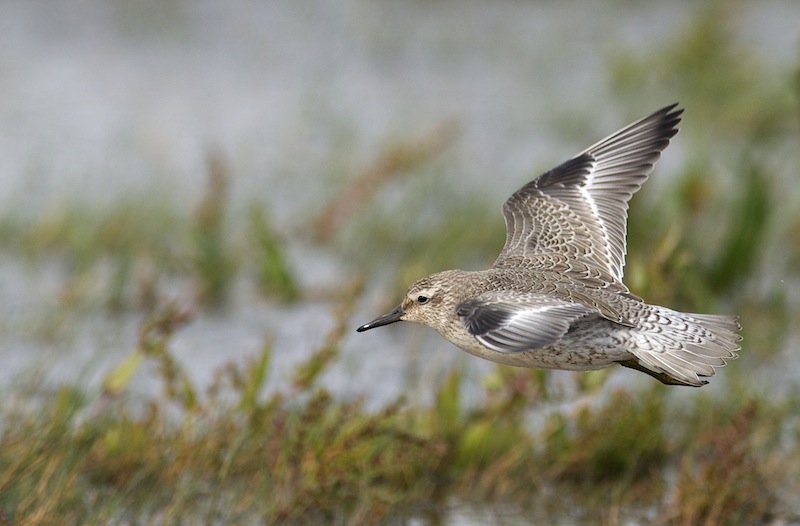
With the prospect of some nice sunshine and good photographs, I set off for Pennington Flash today in search of a photograph of a bird that I've not got very close to before - the Knot.  A single bird had been reported on the Manchester Birding Forum for a couple of days and it seemed to be sticking around.  There had also been a couple of special birds that had caused a bit of a birding commotion here last weekend - a Black Tern and an American Black Tern, but there was next to no chance of them being here today.

The end of the Spit

When I got to Horrocks Hide, the vegetation on the spit had been cut down and visibility was much better than last time I came.  It was good to see the Lapwings and Cormorants back in some numbers as well as the usual Black-headed Gulls. I met Barry Hulme and Bill Harrison in the hide and they told me the Knot was showing at Ramsdale's Hide round the corner - so after a quick look around during which time I managed to spot a Pochard and a Great Crested Grebe, I set off in search of my goal.

Knot from Ramsdale's Hide

I found the Knot almost immediately, and then spent most of the time wishing it would come closer. The mid-morning light at Ramsdale's Hide is not great for photographs, and so I wasn't really happy with any of the distant photos I took today - ah well, I'll just have to come back when the birds are closer.

Knot my best photos!

I couldn't see the Green Sandpiper here today either but there were a couple of Little Grebes diving in front of the hide as well as some Teal, Mallards, Coots, a Gadwall pair and some Shovelers.

Little Grebe from Ramsdale's Hide

I left Ramsdale's and walked round to the viewing area overlooking the far end of the spit. There is usually a Kestrel around these parts and today was no different, although it didn't hang around for long.  I noticed that a chunky new structure had been built high up on the canal bank overlooking the Flash, and wondered if it was for viewing the area - I'll have to investigate this on my next visit, I thought to myself.

The unmistakable bill of a Shoveler - a male in eclipse plumage

With nothing much showing here, I set off back through the woodland walk to Teal Hide, and chatted to a couple of birders on the way.  At Teal there was a group of seven or eight Shovelers, the males being in eclipse and looking quite similar to the females.  But the water level was very high and there was no chance of any waders, just the 'usual suspects' of Coots, Moorhens, Mallards and a pair of Gadwall.  A single Mute Swan was also present. Barry and Bill caught up with me here, and told me that a pair of Greenshank has landed near the spit and were giving Jon Taverner some very good views in front of Horrock's Hide - I just had to return, and quickly.

On the way back to Horrocks, I called in briefly at Lapwing Hide, where the vegetation is so high you can't even see the water and Pengy's Hide where there just a couple of Mallards and Coots.  No point in staying here I thought, and made off in search of the Greenshank.

Greenshank from Horrocks Hide

When I got to Horrocks, Jon Taverner was firing away with his big 500mm prime lens and 1.7x teleconverter.  The birds were in his ideal position, well-lit and only 5 metres or so away.  I struggled to get my camera gear out and setup quickly enough, whilst all the time the birds were moving away.  I quickly fired off a few shots just to get 'something' in case they disappeared.  Then I settled down a bit and waited for them to get into a good position.

Greenshank pair resting

The Greenshank did a tour of the whole spit and were chased by Lapwing on several occasions. But unfortunately, whilst I was there, they didn't come close to the hide again. However. I did get my best ever shots of a Greenshank here today. There were also four or five Common Snipe lurking in the vegetation and occasionally coming out in to the open, but they were too far away and too well-camouflaged for photos.

Grey Heron from Tom Edmonson's Hide

After chatting to Jon (who was fairly well-satisfied with his own Greenshank shots) and a couple of other birders, I decided to go back to Tom Edmonson's Hide which I'd skipped on the way to Ramsdale's when looking for the Knot.  I was hoping to see a Kingfisher, as they have been reported here quite frequently.  When I got to the hide, a Grey Heron was perched on a post in front of the viewing area.

Grey Heron

I love Herons, and so I spent most of my time taking photos of it and another juvenile which appeared later and which went fishing.  I did briefly get a glimpse of a Kingfisher,  an iridescent blue flash across the water, but that was all.

Grey Heron Landing

On the way back to the car I called in briefly at Horrocks again, just to see if the Greenshank had come close again - they had, but had then disappeared to the far end of the spit.  And so I went home quite satisfied with my birding activities and with two new birds to add to my year and life list.

Tuesday, 4 September 2012

Rumworth Lodge, near Bolton

I had a great day out with Keith Mills who showed me around the Rumworth area on the outskirts of Bolton. Here's a summary of what we saw today:

Main Lodge 
  • 1 Great Crested Grebe with largish humbug in tow 
  • 3 Grey Herons, great to see two in flight together 
  • Kestrel being mobbed by crows as it hunted 
  • Lots of Swallows about, especially around the farms 
  • A few Tufted Ducks and Mallards Lots of Coots and a few Moorhens 
  • Many Black-headed Gulls and Crows 
  • Several Mallards by the dam, one female having four juveniles 

Lock Lane
  • Lots of Jackdaws
  • House Sparrows 
  • Starlings 
  • Swallows 
  • Large flock of Woodpigeons in the distance

Oh yes, and really unusual decoy machine in a farm field near Beaumont Road with two 'woodpigeons' rapidly spinning around on it.  For a moment we both thought that they were real 'dead' birds on them as their wings flapped whilst it spun round.

Nothing really special, but very enjoyable company - cheers Keith.