Wednesday, 25 April 2012

A Walk in Lilford Park


I spent a hour or so at Lilford Park in Leigh today in a sunny break between the showers we've been having this week.  I went in search of the Green Woodpecker which is well-known but not often seen here, but the highlight turned out to be something quite different.  More on that later.


As soon I had walked through the park gates I found this Song Thrush digging for worms under a Weeping Willow tree. This part of the park is probably the prettiest at the moment with manicured lawns and well-tended flower beds as well as the beautiful long Willow branches which gently sway in a slight breeze. (I should have take a picture!)

When I walked down the main central path, I was surprised by how bright it looked at the far end, and then I realised that a large number of trees had been removed in and around the area which used to be the old zoo here.  I talked to a couple of people about this who, like me, were extremely unimpressed by this butchering of the parkscape.  Its seems to be something to do with extending the flood basin which divides the park from the meadows and woods on the other side of the small stream.  I asked if they'd been consulted or if notices had been put up about these changes, and neither people had been told or seen anything about it - it all happened very quickly.

Can you see Old Mother Willow's face in this tree?
In recent times a new footpath has been created along the flood channel, and I was walking down it when I saw my first ever Chiffchaff which I happily reported in this post last year.  The route up to the path has now been altered slightly due to the work going on here, but as I approached it I heard the distinctive 'yaffling' call of a Green Woodpecker amongst the many other birds that were singing.

Crow with a packed lunch

On reaching the path, I first saw a Carrion Crow carrying what appeared to be a sandwich in its bill. It flew parallel to the path and into a tree in Atherton Wood where it started to eat the bread.  As I was watching the crow, I caught a brief glimpse of another bird flying across the edge of the wood.  At first I thought it was a Thrush, but when I held my camera to my eye to take a shot, I soon realised that it was what I had come here for - a Green Woodpecker! Unfortunately the bird was moving too quickly and landed on a tree a bit too far away for a good photo, but here's my record shot anyway:


As I walked down the path a pair of Blue Tits flew in front of me and then over to Atherton Wood.  I dropped down back into Lilford Woods where I found a Robin feeding a young fledgling which was fluttering its wings, a male and female Blackbird playing 'chase' and a cock Pheasant which beat a hasty retreat when it saw me approaching. There was also another Green Woodpecker yaffling away somewhere, but I couldn't quite make out where exactly.

A Common Buzzard and Grey Heron flew over me as I wandered through the woods - it was incredibly quiet and peaceful except for the chattering of a few birds now and then.


In order to find some Woodpeckers I started to look for holes, especially in soft, dead Silver Birch tree trunks and whilst doing this I came across this Great Tit nestbuilding in a deserted Woodpecker hole.


A Face-full of Moss


I watched this little bird to-ing and fro-ing from the nest hole for about 20 minutes, only looking away for a minute to find a Great Spotted Woodpecker hammering away high up in another tree.  Before moving on I took this closeup photograph of some Wild Garlic.


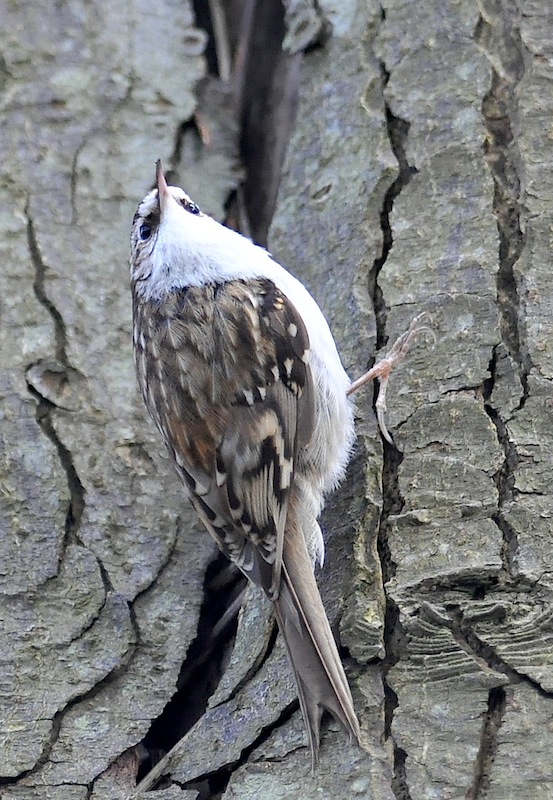
I continued to look for more holes in case they might be filled by a Woodpecker this time but as I went round doing this, I came across something quite unexpected - a pair of tiny Treecreepers building a nest in the loose bark of a dead tree.  I watched them for about half an hour whilst taking a few photographs. Here are the best of what I got:


It's quite amazing how they grip the bark with their long toes.


A Classic Treecreeper Pose !


The light changed and so did the colours

Ain't that Cute?

Well, I spent far longer here than I intended and I was quite happy with what I'd seen, in spite of not having had much opportunity for taking photographs of a Green Woodpecker.

On my way out I was greeted by two people sitting on a park bench and enjoying the sunshine.  They were a very nice couple called Allan and Janet Roberts and they asked me about my camera as walked past - this is how we got talking about a whole host of things including bird photography, what was being done to the park, the new Guided (some say 'mis-Guided') Busway being created from Leigh to Manchester and other such stuff.

It hadn't taken me long to guess that Allan and Janet were retired teachers and, as it turns out, they actually live quite close to me in Tyldesley.   They were really enjoying their retirement and hadn't regretted the decision for a minute. I took them back into the woods to show them the Treecreepers and they seemed to be enthralled by the birds.  Later back at the cars, we exchanged e-mail addresses so that we could keep in touch about starting or joining an action group to look after Lilford park.

Allan e-mailed me in the evening (reposted in the comments below) with some positive comments about this blog and the following web address for anyone interested in giving their support in restoring Lilford Park to its former beauty - Friends of Lilford Park.

When I got home I updated my sightings on the map of Lilford Park from my Where-2-See Birds website. Here's what it currently looks like:


View Lilford Woods Bird Sightings in a larger map
So an unexpectedly pleasant afternoon outdoors in the sunshine with some very nice people - it doesn't get much better that that, does it?

Monday, 23 April 2012

Another Sparrowhawk in my Garden

First Sight of the Sparrowhawk

A Bit Closer

It's funny, but once you start looking it's amazing what you actually can see in your own 'back yard'. I'd never imagined that I'd ever get a bird of prey in my suburban garden here in Tyldesley.  But then earlier this year I saw my first Sparrowhawk as I posted here.  And today I saw another, this time a lot less bedraggled from the weather and looking very fine indeed.

Turning Around

One thing I've learnt over the last three years is that with birds, you must take your shots while you can - look away for an instant and they can be gone.  And so, to get these photos, I just shot them through the kitchen and later the patio windows, muck and all!  If I'd even attempted to open the windows the bird would have flown, and there was no hope of going outside into the back garden.

Showing An Interest

I had actually suspected that there was a bird of prey around, because last week I found a large number of Wood Pigeon feathers scattered across my back lawn.  Our two cats are always very interested in any birds in the garden, and Wood Pigeons in particular, but I don't think they'd manage to catch one - I also couldn't find any remains of a body, which is what usually happens when they do manage to catch a bird.  They play around with it for a while and carry it from place to place, before getting bored with the fact that it's not moving any more. A sad fact of the cycle of life I'm afraid.

A Bit Ruffled

So in this case I suspected that a Sparrowhawk had caught it, and presumably taken it away to eat. Unfortunately, like so many garden feeding stations, our feeders seem to have become a Sparrowhawk feeding station too.  This bird was sat on the fence overlooking the feeders in exactly the same place as previously, and it may have even been the same indivivual.  The largest group of feathers was almost directly below the feeders, and so my guess is that the Sparrowhawk grabbed the Wood Pigeon whilst it was on the feeding table, killed it and then flew off with it leaving only the feathers scattered across the grass.

A Closer View

Of course I didn't see any of this so it all just supposition, but I'm fairly confident that's what happened here.  So there you have it, a few male Sparrowhawk shots taken through mucky glass, and that said, I'm quite pleased with them.

A Bee Flies Past

Wednesday, 18 April 2012

Post-Easter Eggs

Whilst out in the garden last weekend I found an egg on my back lawn.  It had a small hole in it and the yoke could just be seen.  At first I thought our cat's might have raided a nest because they're winning 3-0 against the birds this year, with a further two of the ones they've caught surviving at least for a while after I released them. But I'm not sure that cats are interested in birds' eggs and so I now think a Magpie or a Crow might have dropped it whilst flying over the garden.


Then a day or so later my wife Sarah was giving the grass it's first cut of the year (she wanted to, honestly!) and she found another egg, this time completely intact. She was certain it wasn't there when she started, although the grass was a little long in places, and so we presumed it had fallen out of the sky, favouring the Magpie or Crow scenario.


At around 4cm long, the eggs are larger than most common eggs I've found in and around my garden over the years, and they are also a smooth featureless white colour. They might not even be both from the same bird as the broken one on the left is a little longer and a bit more pointed at the ends than the one on the right, which is ever so slightly pinker in colour.

My best guess at the moment is that they belong to a Wood Pigeon, or perhaps a Collared Dove but I'm open to suggestions for correctly identifying them.


If you've any ideas to which bird these eggs belong and how they ended up on our back lawn, we'd be interested in hearing from you - just click on 'comments' below this post and, after writing your message, use the 'Anonymous' identity to log it for speed if you like.

Saturday, 14 April 2012

Dunham Massey Park

Today I decided to hunt for the elusive Green Woodpecker and (even more elusive) Lesser Spotted Woodpecker which are actually seen fairly frequently at Dunham Massey Park.

A favourite activity of most birders visiting this location is to go for a so-called hat-trick of Woodpeckers, by seeing the Green, Great Spotted (GSW) and Lesser Spotted Woodpeckers (LSW) all on the same day - a tough assignment when I've only ever seen one before, but I knew there would always be plenty of other interesting things to see here such as the deer, as well as good views of Nuthatches and perhaps Treecreepers.

I had only been driving for about five minutes when I realised I'd left my National Trust membership card at home and, without it, parking would either be expensive or very difficult.  So I turned off the East Lancs Road and went down a cut through back towards Astley Green in order to return home.

However, as soon as I approached Higher Green Lane I noticed a Kestrel flying very low over the fields here and, as the sky was blue and almost cloudless at this point, I decided to try for some photographs.  The best of what I got are shown here:


Later I also got a Lapwing and a Goldfinch in the same area:


After this short but very enjoyable distraction, I returned home for my card and then set off once again for Dunham Massey Park.  The first bird of note I saw was a Grey Heron high up in a tree on the north western edge of the Moat pond.

After getting my entry ticket (free to NT members), I walked under the entrance arch and soon spotted two Buzzards circling high up over the formal garden in front of the house.

I set off along Charcoal Drive where there were many Fallow Deer grazing on the grass. 


Whilst taking this photograph I could hear a Green Woodpecker near the Smithy Pool. Today was also Jackdaw-city here at Dunham.  These noisy birds were 'chacking' everywhere I went.


I saw a male Kestrel on the way to the Deer Barn, but there were no Green Woodpeckers on the anthills here today.  However I could still hear one (and later several more) and so I made my way in the direction of the 'yaffling'. This took me back to the Smithy Pool.

Here I accidentally flushed a Green Woodpecker from the ground which then flew into a tree in the fenced off area near here.  I fired off a couple of shots, but got nothing worth showing - however, they were enough to say I saw a Green Woodpecker today.

There was also a beautiful male Kestrel sitting in the same tree, although it could have been the same one that I has seen earlier - it flew out of the fenced area and into a tree on the edge of Smithy Pool.


After hanging around for half an hour or so and hearing but not seeing the Green Woodpecker again, I decided that was going to be it for today.  I headed off back across Charcoal Drive towards the old Slaughterhouse building where I immediately spotted this Nuthatch working a tree outside it.


This is my best picture of the day - a classic Nuthatch downward pose.


This Carrion Crow also flew directly over me outside the Slaughterhouse.


After having a look at the displays inside the Slaughterhouse, I crossed over Main Drive and made my way to the Island Pool where there was a Mute Swan and a single pair of Tufted Ducks looking very picturesque amongst the lilies. 


After walking round the pool I found this Blackbird gathering worms from under the trees on the edge of the Deer Park. I wondered if it could possibly have any young yet?


Finally I set off towards the Obelisk looking for the Lesser Spotted Woodpecker.  As I looked around I saw a Song Thrush on the ground and another Nuthatch, a Great Tit and some Blue Tits in the trees.  And then I saw it! A flash of black and white and a bit of red. I took a few pictures as record shots and I thought I'd cracked it, patting myself on the back for an excellent find. Now I only needed the GSW for the hat-trick.

I followed the bird as it flew around from tree to tree, trying to get a better photograph. Whilst looking up amongst the treetops for where it had landed, a National Trust Ranger approached me and asked if I'd seen the LSW, to which I said 'Yes'. We chatted for a while about birds and he showed me a fresh hole which had been made by one and then told me someone had videoed it making this hole and put it on YouTube. Here's the video:


We looked up at another hole at the top of a large grey-barked Beech Tree and two GS Woodpeckers landed on it as we spoke, with one going into the hole.  'Great - there's my hat-trick', I thought to myself.

The Ranger went on to tell me lots of stuff about the wildlife and trees in this area and I even learnt a new word today - epicormic, the name for the growth of vegetation around the trunks of Lime and other trees. And after that we parted company and I went home happy, for a while anyway.

However, when I closely examined the one decent photograph I had at home, it was actually a Great Spotted Woodpecker that I had seen.  How could I be so stupid? It was much too big for a LSW and I'd mixed the wing patterns up - it seems I scored an own goal rather than getting a hat-trick. Unfortunately, I'd already made report on the Manchester Birding Forum before I realised this, and I haven't worked up the courage to tell them I was wrong yet!

Well, it seems I didn't get to see the Lesser Spotted Woodpecker after all today, so that just gives me a reason for going back to this great place.  For now I'll have to make do with this video of one excavating the hole in a tree here - at least I saw the actual hole today!

Here's what my Dunham Massey Park map looks like now:

View Dunham Massey Park in a larger map

It's a great place and a fantastic half or full day out, even if you only walk around the park.  There's a public right of way through the middle of the park, so you don't even need to pay as long as you can find somewhere safe and sensible to park your car.

Postscript:

I couldn't write this post without including some more photos of the wonderful deer here, which roam freely in amongst the people throughout the park as well as having their own sanctuary areas.


Thursday, 12 April 2012

In Search of the Great White Egret (in Abram)

Tim Wilcox?
I spent a great day out at the Abram Flashes to the south of Wigan today, most of the time with fellow (but much more experienced) birder Tim Wilcox, whose avatar on the Manchester Birding Forum is David Suchet of Inspector Poirot fame (and boy does he look like him!).  The sun was shining and the sky was blue with some wonderful fluffy white clouds - I even got a bit sunburnt! We had both gone out in search of the Great White Egret which had been reported here several times in the last few days, and so we really were expecting to see it.  More of that later.

As I parked at the Dover Lock pub rear car park, where the landlord kindly allows birders to park, I was greeted by the sound of Chiffchaffs and Great Tits. And as soon as I set off walking along the towpath under the canal bridge, I was met by two Mute Swans on the Canal, a Grey Heron flying over and a couple of Blackbirds in breeding mode. 'A good start', I thought to myself.

The first pool you see from the canal is Dover Basin, where I managed to miss the Osprey which stayed around here for a few days in 2010 (grrr - it still gripes with me). On the water there was a pair of Great Crested Grebes, some Tufted Ducks, Coots and Mallards. On my way down the steps to the excellent new footpath which has been created along the bed of a old long-disused railway line, I could hear a Willow Warbler - my first of the year.  Not only did I hear it, but I also got a great view of it for a couple of minutes, but not long enough for me to get my camera out for a photo.  There were also quite a few Lapwings on Lightshaw Meadows.

I'd been down to Lightshaw Meadows in late January this year, when Pete Alker from Wigan Leisure and Culture Trust led a short 4.5 mile round trip from Pennington Flash on their 'Big Garden Birdwatch' day.  He'd explained the work that was going on here to revert the meadows back to their natural state and how Longhorn cattle were being introduced as part of the process. The Longhorns will be instrumental in 'conservation grazing' in order to make the meadow more suitable habitat for bird species such as redshank, lapwing and snipe.  I could clearly see fifteen or so of them doing this from quite a way off today.

Longhorn Cattle

Shortly after this I met Tim on the footpath, who was also in search of the Great White Egret, but with no success so far. We introduced ourselves and had a nice chat about all things birding, and in the process exchanged phone numbers so that we could text each other should one of us find the bird. I then set off for the new viewing screen at the western edge of Lightshaw Hall Flash, whilst Tim headed back up to the canal towpath to look down on the small pool on the northern edge of the main flash, which is mostly hidden from view down here.

As soon as I approached the viewing screen, I could see a white shape on the far side of the Flash and so it was with some excitement that I took out my binoculars to get a better look. Unfortunately, it was not the Great White Egret for which I was hoping, but a Mute Swan preening itself in a small depression in the ground.  Soon another swan bobbed it's head up, followed by three and then four Greylag Geese.  'Oh well, there's still plenty of time left to find it', I thought.

Alert Male Wheatear

The viewing hide is in a lovely location, but it really needs a spotting scope to view the Flash as the birds are still quite some distance away.  Fortunately I had brought mine with me, and so my camera stayed in it's bag for most of my time here. With my scope I could see two Oystercatchers, four Shelduck, many Lapwing, a few Teal and several Black-headed Gulls.

Two male Wheatears


After 45 minutes or so I was joined by two fellow birders also in search of the Great White Egret and together we saw two distant Buzzards, some Redshank and my best sighting here, a pair of male Wheatear which came quite close and which forced me to eventually take out my camera for some pictures. Still no Great White Egret though.

My closest and clearest view ever of a male Wheatear

By now Tim had gone back to the car park for his sandwiches and returned to join us at the viewing screen.  We went on to see a Curlew which flew over the screen making a shortened call and a Reed Bunting as well as closer views of the Wheatear.  When the two other birders left, Tim and I decided to walk round to the new viewing screen on the eastern side of the Flash via Lightshaw Lane.  It was a fair walk round, but on the way we saw Yellowhammer, Goldfinches, Skylarks, a House Sparrow, Blue Tits, Mistle Thrushes, a solitary Pied Wagtail and a Jay flying through the woods at the end of the lane.

The view at the eastern viewing screen was a little disappointing being somewhat restricted by early flowering Blackthorn bushes which have only been partially cut back to allow a small viewing area through the middle.  It has probably been left this to maximise the camouflage of the screen and any birders there, and thus minimise any disturbance to the birds, but it doesn't make viewing easy, particularly when all the birds are still some distance away.

Tim and I spent more time looking the other way where we had great views of the two Buzzards coming in to land in their nesting tree, a Jay which did an extended flypast across the fields behind us and a very vocal, low hovering Skylark which eventually dropped to the ground right in front of us. Still no Great White Egret here though!

On the way back along Lightshaw Lane I spotted a Black-tailed Godwit and a Redshank on the Flash and, when Tim trained his scope on them, there turned out to be three Godwits and three Redshank splashing around in the water.  The view from here is one of the best in this area and probably better than the eastern viewing screen.

Having made an appointment to meet Mike Baron at Rixton this evening, I had to leave Tim still looking for the Great White Egret at this point and as I bode him farewell he spotted a Kestrel in the distance, whilst I saw a Wren along the lane and had a great view of a low flying Jay on the main road back to the car.  It seems Tim went on to meet up with some other birders later in the afternoon, but the Egret wasn't seen by anyone here today, although a Kittiwake did fly over Dover Basin.

Back at home in the evening, I updated the Abram Flashes map on my Where-2-See Birds website with details of the parking spot, suggested walking routes to the viewing areas and some of the sightings I had today.  Here's what it looks like now:


View Abram Flashes Bird Sightings in a larger map


A great place and a fantastic day out with a nice fellow birder. Now that's what it's all about, isn't it?

Friday, 6 April 2012

NestCam 2012 Update

I've removed the live NestCam 2012 video stream from the main posts in this blog for the time being as nothing much is happening yet. As soon as there is any activity worth watching I'll put it back online. You can always check here or on the link to the right if you want to see if it's live today.

I'm also working on providing details about how to stream live video from a nestcam (or any webcam or video camera for that matter) for others to view over the internet.  It's not quite finished yet, but you can get a preview of my work so far here or also on the link to the right.

Thursday, 5 April 2012

I've Finally Bitten the Bullet

You may have noticed a distinct lack of photographs in this blog over the last few months. The reason for this is twofold:  firstly I became very unhappy with the quality of the photos I was producing, mainly due to the limitations of my lens, and secondly because the iMac computer I use for picture-editing developed a software fault that rendered it unusable. So the last few posts have been sent from a different computer until now, when I have found a working solution for using my iMac again.


So what about the photos? Well, last week I finally bit the bullet a bought a secondhand lens which nearly cost me both my kidneys.  It's a Nikon 300mm f2.8 AF-S VRII and all you need to know is that means it's a professional quality lens that's bloody expensive.

The reason I bought this lens is that, after fieldcraft and experience in getting close to birds, I believe that lens quality is the next most important thing for a bird photographer, more important than the camera body or any other piece of equipment. I wanted to take the lens out of the equation in sorting out why my photographs are not sharp enough for me.  I also need to be able to carry the lens about all day and so it mustn't be too big and heavy - the 300mm f2.8 fits the bill for this although I will need a 2x teleconverter to get some of the shots I'm looking for.

Here are some of my first attempts at Pennington Flash on a sunny April day, all shot at just 300mm with some cropping and slight sharpening, but no teleconverter as I haven't got one yet:

Great Crested Grebe

Great Crested Grebe

Common Snipe

Common Snipe

Common Snipe

The birds did come surprisingly close on this trip today and so the 300mm was just about long enough to get decent photographs when cropped.  I'm now on the lookout for a secondhand Nikon TC-20e III teleconverter which will give me an easily portable 600mm lens for both handheld and tripod shots.  And before you warn me about this choice (as many have already), this lens is one of the few such lenses that works very well with a 2x teleconverter - in fact I believe it was designed with this lens in mind.

I think you can easily tell the difference in the quality of these photos and what I've put on my blog previously, so from a photographic point of view, this blog will be almost like starting again from scratch.  I can feel a renewed vigour for going out a taking bird photos and writing this blog, so come back soon.

Friday, 30 March 2012

Note to Self

I need to do some brief posts on the following:
  • Sizergh Castle and Leighton Moss
  • Hest Bank and Glasson Dock
  • High Rid Reservoir, Doffcocker Lodge and Moses Gate Country Park