Showing posts with label Mute Swan. Show all posts

Wednesday, 20 March 2019

Sing, Sing, Sing!

A few from Yarrow Valley Country Park in Chorley this week. The Dippers have moved downstream from their favourite place at the weir and there was no sign of the Kingfisher whilst I was there. But 'Billy' the boss Mute Swan cob was parading around scaring everything in his path.


Tuesday, 29 January 2019

A Disappointing Day in Lincolnshire

I been planning this day for a few weeks now and when the weather was predicted to be sunny I decided today was the day to go during last week.  By coincidence one of my Facebook birding friends had messaged me the day before to say that the Bitterns were starting to show well again at Far Ings and, as that was one for the reasons for returning, it gave me even more hope of a grand day out.


I set off at 6am in the dark up the M62 motorway to do the two hour drive to Far Ings, which is just over the Humber bridge in Lincolnshire. I arrived at about 8:30am due to stopping for fuel and missing the turning for the Bridge due to confusing roundabout signs.  I ended up back on the M62 going the wrong way, and you what it's like when this happened to you, there isn't another exit for miles!

Goldeneye here ...

Anyway, I was first at Far Ings, but I was soon joined by Sam Gosnay from Wakefield and we had a nice chat whilst seeing very little.  There were two Mute Swans, some distant Goldeneye, a Grey Heron, some Cormorants and not much else.  A female Marsh Harrier did fly past at one point followed by a male shortly after, but they were on the far side of the reserve so too distant for the sort of photos I wanted.

Mute Swans here ...

The Ness Hide at Far Ings is often said to be the coldest hide in Britain, and after about three hours in the freezing cold wind which blows in off the Humber Estuary, I'd pretty much had enough. No Bitterns or Kingfishers, so two of my targets were dipped.  I left Sam wandering around some other parts of the reserve whilst I headed south into Lincolnshire proper in search of Short-eared Owls.

Marsh Harrier here ...

At the undisclosed location I met up with regular birder Don Davis and his friend and we chatted about all things Owls and other birds. None had been seen so far today and they'd been there since 8:30am - at least I hadn't missed anything.  The day drew on and although the sun was out, it got colder and still no birds were showing. Eventually Don and his friend left as they had things to do

Sam reappeared at around 1pm and later his friend Tony, who I had met the last time I was here. We chatted and chatted and chatted and still no birds appeared. And then one did.


Eventually we counted at least three, possibly four Short-eared Owls in various fields, but none of them came anywhere near close.  We walked up the road and back down, but they always remained just about as far away as they could.  One of the Short-eared Owls had a brief tussle with a Kestrel, which had seen it with some prey on the floor and mobbed it to steal the prey. The Kestrel Didn't get it.


The best bird of the day for us was this Kestrel which briefly landed in tree nearby the three of us.  Unfortunately its wing cast a strong shadow across its face in most of our shots due to the very bright sunlight.


The shot of a distant Short-eared Owl below hasn't actually turned out too badly.  Sometimes a background can make a shot and leaving it uncropped works best.  Looks made for a book cover to me!


Towards the end of the afternoon when the sun started to go down, a Barn Owl came out and then another one appeared and soon we had spotted three.  Just like the Short-eared Owl, the Barn Owls all stayed distant and so only record shots were taken.

Barn Owl here ...

We all decided it was time to go but had one last stop on the way out because Tony had seen a Barn Owl land in a field close the road.  Both he and Sam had missed this Short-eared Owl perched in a tree which I pointed out as I got out of the car.  This was probably the closest we got to one today, but by now the light had dropped completely.


I left Lincolnshire quite disappointed that I hadn't got any good shots of the Owls, Harriers, Bittern or Kingfisher. I can get shots of Kestrels, Cormorants and Mute Swans close to home without travelling over two hours to see them, but that's nature and wildlife for you - totally unpredictable.

When I posted some shots on Facebook today a friend of mine commented that if it was easy, everybody would be doing it.  Funny thing is, I see so many people out there with equipment ranging from cheap and cheerful bridge cameras to expensive DSLRs with big lenses that I thought they were!

Sunday, 16 December 2018

In Search of Shorties at Lunt Meadows

In the not so distant past Lunt Meadows has provided some of the best Short-eared Owl photo opportunities in the North West, with people coming a long way to try for some good shots.  In the last couple of years it hasn't been so great, with seemingly fewer birds stopping over.  The prospects for this season had been looking as if it might be another good year, so off I went in search of Shorties.

After standing around for a couple of hours in a place where an Owl had been recently seen, all I taken was this shot of a Little Grebe hiding in the shadows of the banks of the River Alt.


An hour or so later there was still no Owl, so my thoughts turned to other things whilst I was waiting in the freezing cold.  This Little Egret flew past and so was a prime target. I'm told that Little Egrets used to be very rare in the UK although they've always been quite easy to see since I've been birding. They first appeared in the UK in numbers in 1989 and first bred in 1996. 


Nowadays we hardly look twice at them when once they would have been highly twitchable. The same is also happening to Great White Egrets and Cattle Egrets too, and one day they may be as common as Little Egrets on the north-west coastal reserves and estuaries. Whatever next, Spoonbills? They are breeding successfully in Yorkshire. Some rather unusual light in this shot, probably enhanced by the out of focus background.


Lunt Meadows are a great place to photograph Kestrels and if the opportunity arises I will always take it.  Such a great bird to capture in flight.


Kestrels make a great portrait shot even when they are sitting on a man-made object.


It was great to see a family party of Mute Swans flying past, but I wish it had been an Owl.


I'll finish with a shot that I'd normally delete - there's something about this habitat shot that I like because it sort of sums up Reed Buntings.  No Owls for me there today then.


Sunday, 20 August 2017

An Afternoon at Dunham Park

A short video from Smithy Pool at Dunham Park:

Friday, 2 June 2017

One Good Tern Deserves Another


I was going to Preston today to have a look at Charlotte Ball's photographic exhibition. Charlotte has been accompanying the L.O.S. on a number of fieldtrips this year as part of her degree project at the University of Central Lancashire in Preston. As is usual with type of arts course, the students create an exhibition of their work in the third year and so I went to have a look.


As I was going to be in the area I thought I'd also tie it in with my first visit to see the Terns at Preston Marina this year. Common Terns and sometimes Arctic Terns breed at the Marina in gravel boxes created by local school children, but I wasn't quite sure at what stage they'd be in terms of eggs and chicks. Today I could only see one Arctic Tern which seemed to be nesting on one of the platforms.


As soon as I arrived I realised that the birds were on eggs, but that no chicks had hatched yet and so I'd have be content with flight shots hopefully carrying fish back to their partners.  I love the green water colour here, but mainly when the sun is shining. When it's not sunny the water is quite a dull murky greyish colour and today it was like that most of the time.


However, I did mange a few closeup shots and saw some interesting behaviour when a Lesser Black-backed Gull passed too close - all the Terns started calling and eventually a few of them took off in a coordinated attack on the gull, successfully chasing it away.  A similar thing happened when a Carrion Crow pass by as well.


There were also a pair of Mute Swans with five cygnets swimming around the Marina.  They'd nested in their usual place amongst the Terns on one of the platforms and unfortunately a couple of eggs were lying unhatched still in the nest. It is far too late for these to hatch now as the adult Swans were busy looking after the mobile cygnets.


It was probably a little early for good shots and I might return in two or three weeks time when the eggs will have hatched and the adults will be actively feeding the young so there will be lots of great photo opportunities for fish and feeding shots.

Friday, 5 May 2017

First Trip to Venus Pool in Shropshire


Following on from my successful day visiting the Night Heron in Shrewsbury, I decided I might as well have a quick look at Venus Pool which was only another 20 minutes or so away. I wasn't really expecting to see much and so it was more of a reconnaissance trip.


I'd heard about this place quite a lot from a Facebook friend called Meurig Garbutt and indeed it was he who gave me the directions to get there.


Venus Pool is a largish lake with a variety of habitats including gravel islands, shallow mud areas and a few reeds.  The area is surrounded by fields and arable farmland. There are three hides which are easily accessible from the small free car park, one of which is a feeding station and I believe several others around the opposite side of the pool, but which require a bit of a walk.  Unfortunately there isn't a circular route all the way round.


I didn't have time to walk to the far hides today, so I concentrated on the three hides near the car park.  Here I saw mainly the 'usual suspects' with the addition of a Yellow Wagtail and Common Sandpiper.


As I left the feeding station hide I met a bloke who turned out to be none other than the 'Shropshire Birder' himself, Jim Almond. We had a brief chat about the site before I realised who he was.  When I did, I introduced myself and told him that he was coming to give us a talk at Leigh Ornithological Society next week. It's a small world isn't it?


Friday, 13 January 2017

Fleetwood Marshes

With the prospect of seeing some Bearded Tits without legs rings, I set off for a quick trip to Fleetwood Marshes this afternoon.  This is a new site for me and so I asked for instructions from Leonard Poxon, whose photos I'd seen on Facebook recently.


Armed with my new satnav, a birthday present from my wife last week, I set off on a cold and windy but very sunny afternoon. I found the location without any difficulty thanks to Leonard's excellent instructions and I was soon on the bridge overlooking the golden reed bed that he had described in his post. I waited over an hour without seeing them before deciding to have a walk down to the river Wyre estuary.

There was nothing much there either and the going was quite tough across the marsh so I soon head back to the reed bed. Another hour and no definite sightings of Bearded Tits. A few Reed Buntings came and went but even those were impossible to photograph as they quickly descended into the reeds as soon as they had landed.

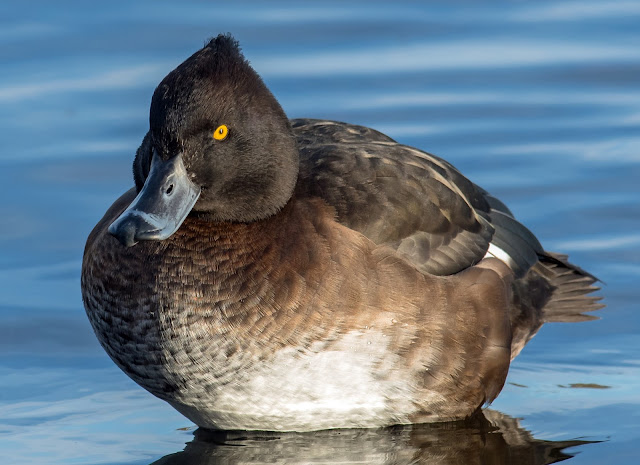
I did think that I might not even get my camera out, but on walk around the small lake I cam across this female Tufted Duck which looked so beautiful in the golden afternoon light - I just had to take a picture! And so I spent the next hour taking photos of common and garden wildfowl and a few Gulls, whilst frequently checking the reeds for the Beardies, but with no luck today,

Tuesday, 16 October 2012

Leighton Moss RSPB

Mark Cain and I had been threatening to go out on a birding trip for a couple of months now, but for one reason and another it had always fallen through - however today we actually managed it and Leighton Moss RSPB was the chosen destination.

The main reason for this was because the Bearded Tits have started to be reported regularly on the grit trays once again, probably because their diet is changing from the insects they eat over the summer months back to seed and grain, for which they need to eat grit to help their digestive processes.  Another target bird was the Water Rail which is seen fairly often here and, if we were really lucky, a Cetti's Warbler might be heard or even seen too.

We set off at 7:30am because most people report the Bearded Tits as being around mainly in the early morning before 10am (although I have also now been told that they can actually appear at any time throughout the day).  The motorway traffic was very slow times and the weather was getting increasingly worse on the journey there, despite the forecast suggesting it would be fine.

Marsh Harrier
First stop was the 'Causeway' at Leighton Moss so that we could head straight for the grit trays and the Bearded Tits - we parked in small lay-by and could soon see a small crowd of people gathered for the same purpose as ours.  On arriving at the trays, there were no birds to be seen for 15 minutes or so, and as the weather was dull and damp, Mark and I decided to head for the Public Hide - this turned out to be an excellent decision as will be seen later.

There was not much to see from the Public Hide: a Grey Heron, lots of Coots and Mallards, a Black-headed Gull as well as a few Gadwall and Teal. But unfortunately the Otters weren't around for us today.

However, there was a lone female Marsh Harrier with a creamy head sitting in a dead tree at the far edge of the water. We watched it for a while in the hope that it might take-off and give up a fly-past but the bad weather seemed to be keeping it down.

Whilst we were watching the Marsh Harrier, both Mark and I heard a distinctive bird call just outside the hide and so we both headed for the door with cameras in hand.  Although I didn't recognise the call, I knew it was something worth looking looking for.

Outside the hide, we had a glimpse of a small brownish bird which flew across the Causeway which we thought it might be a Dunnock - but then we heard it call again and it definitely wasn't. We also heard a slightly different call low down in the bushes which Mark thought could be a Bearded Tit, but not being that familiar with their call, I had to take his word for it.  After unsuccessfully trying to find the bird(s), we returned to the hide where I mentioned that a Cetti's Warbler was often reported down here. That seemed to click with Mark and he said he thought that the first bird was indeed a Cetti's.

We heard it again on the other side of the hide and so went off in search of it.  There was also a very nosey Robin and a noisy Wren in the bushes as we hunted for the Cetti's.  We could hear it moving around and now and then would get a brief glimpse of it.  I took out my phone and played a recording of it's call a few times to confirm that this was what we were hearing and this seemed to attract the bird and keep it fairly close.  We also got a couple of good brief views and both added a new 'lifer' to our lists.

After this bit of excitement, we decided not to go on to the Lower Hide as it was quite a long walk and there was nothing much on the water which it overlooks.  So we headed back to the grit trays for another go at viewing the Beardies.  Another group of people had gathered, but still with no success, so after a quick chat we decided to move on to the hides on the salt marshes.

At Allen Hide we saw Black-tailed Godwits, Redshank, two Little Egrets and a crowd of whistling Wigeon.  We spent a long time debating whether we could see a Spotted Redshank or not, and I told Mark that it definitely was one, only to be told by someone later that it definitely wasn't one!  There were also a couple of Curlew and a Snipe, possibly a Jack Snipe according to another birder.

Red-breasted Merganser (showing sawbill)

At Eric Morecambe Hide we saw three Red-breasted Mergansers, two Grey Herons, a Little Egret, some Shelduck, Lapwing, Mallards and Teal.  Another Marsh Harrier also gave us a long fly-past in the distance.

Both these salt marsh hides have been completely replaced and so they are brand spanking new and smell of fresh wood - lovely!

After this, we decided to go back to the grit trays for a quick look, before eating our sandwiches - what a good decision that was, as two Bearded Tits were now in sight.

Whenever the birds took up a decent pose the photographers fired off a volley of shots in the hope of getting just one decent photograph.  it didn't seem to worry the birds as they didn't fly off and must be quite used to the attention by now.
Female Bearded Tit on a grit tray
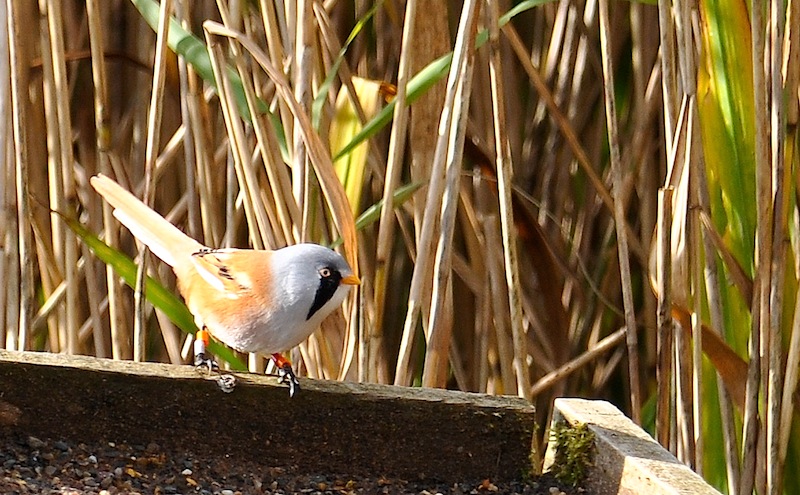
Male Bearded Tit in the reeds
First of all there was a single female Bearded Tit which doesn't have the black droopy 'moustache' and later came the very distinctive male.  Both were a beautiful creamy brown and white colour and they stayed on the trays for 15 minutes or so.

It was such a shame that each bird had three rings on it (two on one leg and one on the other) but they are being actively conserved here and we have to accept that ringing is part of the strategy for monitoring their progress.

Male Bearded Tit
Male Bearded Tit showing full 'moustache'

A Robin joining us for lunch
So after our second 'lifer', Mark and I headed back to the car for our sandwiches.  Here we were joined by one of the many tame Robins that are always present at Leighton Moss.

I know they're very common, but they're such a photogenic bird and they come so close that I can't resist taking just another photograph.


After lunch we headed for Lillian's Hide via the feeding station.

Chaffinch
The feeding station was quite dark today and full of Coal Tits - I've never seen so many in one place before.  There wasn't too much about, but the Chaffinches are always good for a photo.

There were two very well-concealed Common Snipe in the vegetation to the right of Lillian's Hide, some Pochards and Coots and not too much else on the water.  However the highlight was a very brief glimpse of a Water Rail which moved at lighting fast speed into the reeds to the right of the viewing area.

Can you tell what it is yet?
And finally we went down to  Griesdale Hide and Tim Jackson Hide at the southern end of the reserve. I don't often come down here as the sun is not usually well-placed for photographs but I did get a good shot of a female Teal at Griesdale Hide and we could make out a Red Deer stag and two fawns in the bushes to the right of Tim Jackson Hide.

Female Teal basking in the sunshine


So a total of 33 species which I think is quite a respectable total for the day.

A great day out in very pleasant company and I'm already looking forward to the next time I go out with Mark.